A lot of AWD damage happens after the breakdown, not during it. If you are asking can towing damage all wheel drive, the short answer is yes – absolutely – if the vehicle is moved the wrong way.
That is why AWD vehicles need more than a quick hook-up and a fast pull. The towing method matters. The distance matters. Even whether the engine is running can matter, depending on the vehicle. If someone treats an all wheel drive car like a standard front-wheel drive sedan, the repair bill can get expensive fast.
Can towing damage all wheel drive if only two wheels are lifted?
Yes. In many cases, lifting only the front wheels or only the rear wheels can damage an AWD system.
All wheel drive vehicles are built so power is managed across all four wheels through a transfer case, center differential, coupling, or similar drivetrain components. When only one end of the vehicle rolls on the road while the other end is off the ground, those parts can be forced to rotate in ways they were not designed to handle during towing. That can create heat, internal stress, and wear.
Sometimes the damage is immediate. Sometimes it shows up later as drivetrain noise, binding in turns, warning lights, or a vehicle that no longer drives the way it should. That delayed damage is part of what makes improper towing such a problem. A driver may think the car was moved successfully, then find out later that the towing method caused a second issue.
This is especially true with newer crossovers, SUVs, and performance cars that use full-time AWD or electronically controlled systems. These setups are convenient on the road, but they leave less room for guesswork when the vehicle needs to be towed.
Why AWD systems are different during a tow
A two-wheel drive vehicle is usually more straightforward. If it is front-wheel drive, the drive wheels are in front. If it is rear-wheel drive, the drive wheels are in back. With the proper setup, a tow operator can sometimes lift the drive wheels and prevent the drivetrain from turning.
AWD does not work that way. Since all four wheels are connected through the drivetrain in some form, moving two wheels on the pavement can still affect internal components. On some vehicles, that can damage the transfer case. On others, it can affect the center differential or transmission. The exact weak point depends on the design.
This is why owner manuals for AWD vehicles often call for flatbed towing. It keeps all four wheels off the ground and avoids forcing drivetrain parts to rotate while the vehicle is disabled.
That is also why experienced operators tend to be cautious with Subarus, Audis, many BMW xDrive models, AWD Hondas, Toyotas, Fords, and electric vehicles with dual-motor setups. The badge may just say AWD, but the towing instructions can vary quite a bit.
Flatbed towing is usually the safe choice
In real roadside situations, the safest answer for most AWD vehicles is a flatbed.
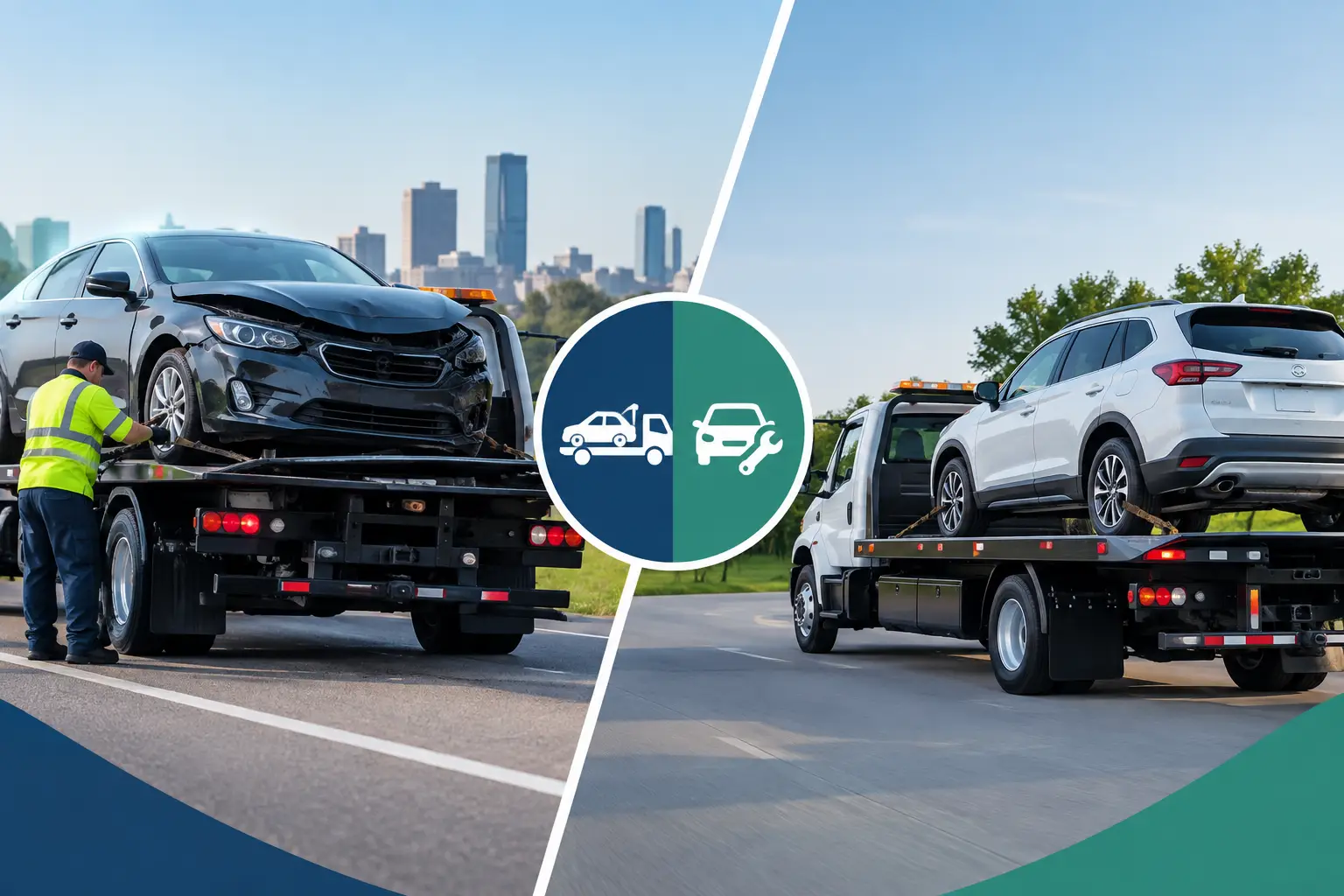
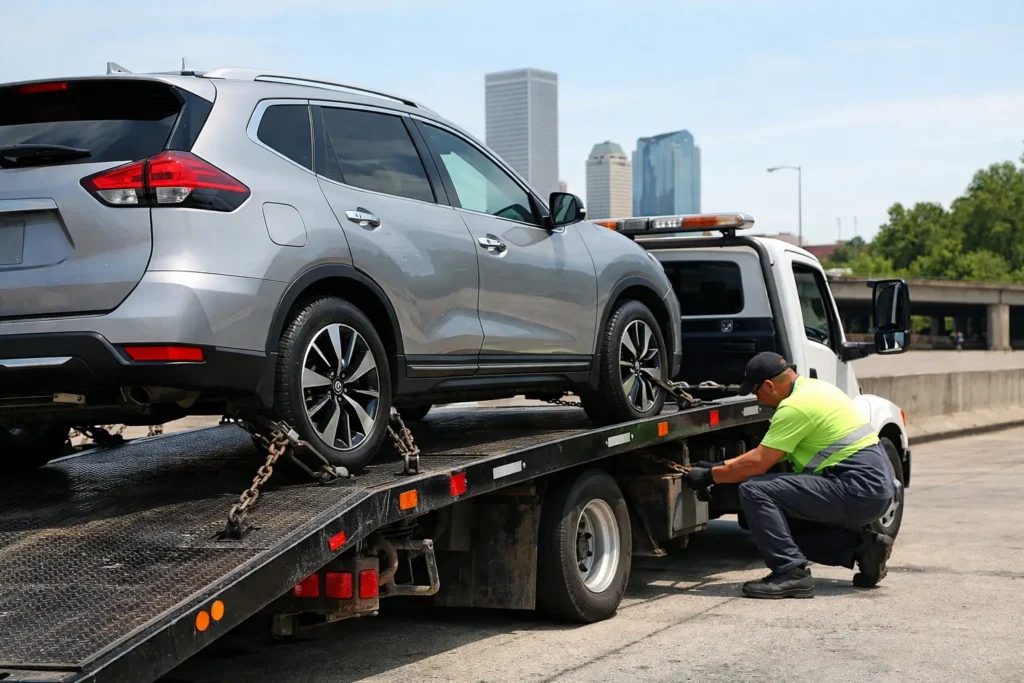
A flatbed keeps the entire vehicle up off the road. That removes the risk that comes from dragging one axle while the other stays lifted. It also helps protect low-clearance bumpers, wheels, and tires during loading and transport. If the vehicle has been in an accident, has a locked transmission, or will not roll freely, a flatbed is even more important.
This is the approach used by careful towing companies that focus on damage-free transport rather than just getting the vehicle moved. Proper loading angles, wheel securement, and winching technique all matter, especially with AWD vehicles that already have a drivetrain issue.
In and around Tulsa, this comes up often with breakdowns on I-44, Highway 169, and busy shopping center lots where a driver just wants the car moved quickly. Quick is fine, but quick without the right equipment can turn one problem into two.
When people get into trouble
Most towing damage to AWD vehicles happens in a few common situations.
One is when a vehicle is towed like a two-wheel drive car because the operator does not check the drivetrain. Another is when someone tries to pull the vehicle with a dolly without confirming whether the manufacturer allows it. A third is when a driver has a friend tow the car with straps for “just a short distance” and assumes that short means safe.
Distance does matter, but not in the way people hope. A short tow done the wrong way can still cause damage. The issue is not only miles. It is the fact that drivetrain components may be turning without proper lubrication or under abnormal load while being pulled.
There is also a difference between emergency repositioning and actual transport. Moving a disabled AWD vehicle a few feet to get it out of traffic is not the same as towing it across town. But once that vehicle is going any meaningful distance, the right setup matters.
Can towing damage all wheel drive even in neutral?
Yes. Putting an AWD vehicle in neutral does not automatically make it safe to tow with two wheels on the ground.
That is a common misunderstanding. Neutral disconnects some power flow, but it does not change the design of the AWD system or guarantee that internal drivetrain parts are protected. On many vehicles, components can still rotate during towing. If the engine is off, some systems may not be lubricated the way they are during normal driving.
That is why neutral is not a shortcut around proper towing procedure. The manufacturer instructions still control. If the manual says flatbed only, neutral does not change that.
What about dollies and recreational towing?
This is where things get more vehicle-specific.
Some all wheel drive vehicles cannot go on a tow dolly at all. Others may allow very limited procedures, but only under exact conditions. Recreational towing behind an RV is a separate issue and not something to assume is safe just because another vehicle can do it.
If a driver is unsure, the best move is simple – do not guess. Check the owner’s manual or use a tow service that understands AWD handling. A wrong assumption can cost far more than the tow.
For disabled vehicles, especially after a collision or mechanical failure, real-world practice is usually more conservative than what people hope to hear. If the car will not start, if the transmission is questionable, if a wheel is damaged, or if the parking brake is stuck, a flatbed is the practical answer.
Signs your AWD may have been towed the wrong way
Sometimes the problem shows up right away. Sometimes it takes a little driving before the symptoms become obvious.
Watch for grinding, humming, or whining from underneath the vehicle. Pay attention if the car jerks in turns, feels like it is binding, or shows AWD, traction control, or transmission warning lights. You may also notice fluid leaks or a burning smell after the tow.
None of those signs automatically prove towing damage, but they are enough reason to stop driving the vehicle and have it checked. Continuing to drive an AWD system after damage starts can make the repair much worse.
The safest move when your AWD breaks down
If your all wheel drive vehicle is disabled, tell the tow company it is AWD when you call. Do not assume they will ask. That one detail changes how the job should be handled.
It also helps to mention whether the car starts, whether it rolls, whether it is stuck in park, and whether any wheels are damaged. Those details tell the operator what equipment is needed and help avoid delays on scene.
A careful tow should not feel rushed or vague. You should be told how the vehicle will be loaded and where it is going. If the answer sounds uncertain, that is a problem.
For AWD vehicles, proper towing is less about speed and more about doing it right the first time. That is especially true when the vehicle already has enough going wrong.
Tulsa Towing handles this type of transport with flatbed equipment because the goal is simple – move the vehicle safely without adding drivetrain damage on top of the original issue.
If your AWD vehicle breaks down, the best decision is usually the least complicated one. Keep all four wheels off the road, use the right equipment, and treat the tow as part of protecting the vehicle, not just moving it.