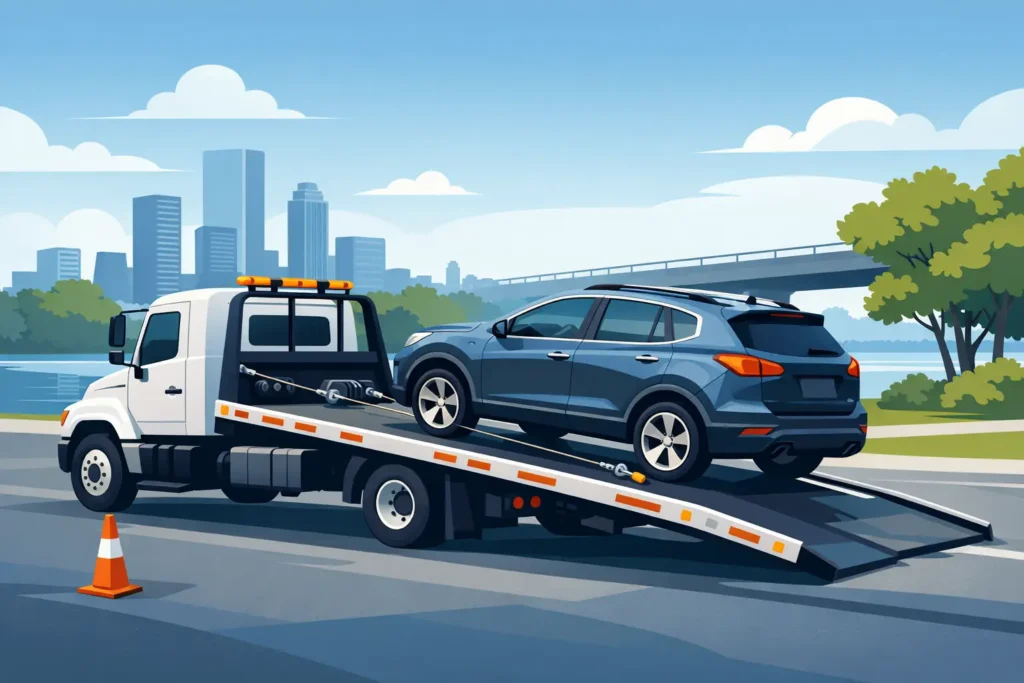
A disabled AWD vehicle should not be treated like a basic two-wheel-drive tow. Can flatbed tow all wheel drive vehicles safely? Yes. In most cases, a flatbed is the correct and safest way to move an all-wheel-drive car, SUV, truck, or EV because every tire stays off the road during transport.
That matters when you are stuck on I-44, US 75, Memorial, or in a parking lot with a vehicle that will not start or cannot be driven. The goal is not just to get the vehicle moving. It is to get it to a repair shop, dealership, or home without turning one problem into drivetrain damage.
Why AWD Vehicles Need Different Towing
An all-wheel-drive system sends power to more than one axle. Depending on the vehicle, it may constantly drive all four wheels or engage the second axle automatically when traction changes. Either way, the front and rear wheels are designed to work together through the transmission, transfer case, center differential, clutch pack, or electric drive system.
When only two wheels are lifted and the other two are left rolling on the pavement, those components can be forced to rotate in ways they were not designed to handle. Even if the engine is off and the transmission is in neutral, the wheels still turn internal drivetrain parts.
The result can be expensive. A short tow may create heat, wear, binding, or damage to the transmission, transfer case, differentials, or driveline components. Some vehicles have limited exceptions, but those exceptions depend on the exact make, model, drivetrain, and manufacturer instructions. They are not something to guess about on the side of the road.
A flatbed avoids that risk. The vehicle is loaded onto the truck, secured at the proper points, and carried with all four tires off the ground.
Can Flatbed Tow All Wheel Drive Without Causing Damage?
Yes, provided the vehicle is loaded and secured correctly. Flatbed towing protects an AWD vehicle from rolling drivetrain damage because its wheels are not turning during transport.
Proper loading still matters. An experienced operator checks whether the vehicle can roll freely, whether the electronic parking brake is engaged, whether the vehicle is in park, neutral, or a fault mode, and whether it has low ground clearance. The winch line and tie-downs need to be placed correctly, not simply attached to the nearest visible component.
For a vehicle that will not go into neutral, has locked wheels, or suffered collision damage, the loading process may require extra care. Skates, dollies, or other recovery equipment can be used to move the vehicle onto the bed without dragging it across pavement or forcing damaged wheels to roll. This is common after an accident, a mechanical failure, or an electrical issue that leaves the shifter unresponsive.
The flatbed itself is only part of the job. Damage-free towing comes from using the right equipment and knowing how to handle the vehicle in front of you.
Why a Wheel-Lift Tow Can Be Risky for AWD
A wheel-lift truck raises either the front or rear end while the other tires remain on the road. This can work well for some front-wheel-drive or rear-wheel-drive vehicles when the correct drive wheels are lifted. With AWD, it is usually not the first choice.
The issue is that an AWD vehicle does not always behave like a two-wheel-drive vehicle with an extra traction feature. Its drivetrain may be mechanically connected from front to rear, even when the system seems to be operating in a normal mode. Towing it on two wheels can make internal parts spin at different speeds or without proper lubrication.
Some owners hear that a very short tow is fine. Sometimes a manufacturer may allow a limited distance under specific conditions, but that is not a blanket rule. It may require the transmission in a certain mode, a specific speed limit, or all wheels supported by dollies. If there is any doubt, flatbed transport is the safer call.
This is especially true when the vehicle is disabled and you do not know why. A warning light, no-start condition, transmission problem, accident damage, or seized wheel can all change how the vehicle needs to be moved.
Not Every AWD System Is the Same
The AWD badge does not tell the whole story. Subaru, Audi quattro, BMW xDrive, Mercedes-Benz 4MATIC, Acura SH-AWD, Ford AWD, Toyota AWD, and many other systems have different designs and towing instructions.
Some vehicles use a traditional mechanical transfer case. Others use electronically controlled clutches. Hybrid and electric AWD models may use separate electric motors at the front and rear. The towing requirements can be very different, but the practical answer remains simple: when all four wheels are on a flatbed, the vehicle is not being driven through its own drivetrain.
Manufacturer guidance should always be the final authority for a specific vehicle. If you have the owner’s manual available, look under “towing” or “recreational towing.” But during a breakdown, most drivers do not have time to sort through drivetrain exceptions. Let the dispatcher and tow operator know the vehicle is AWD, then request a flatbed.
EVs and AWD: Flatbed Is Usually the Right Move
Many electric vehicles are all-wheel drive, including dual-motor Tesla models and AWD versions of other EVs. They should generally be moved on a flatbed unless the manufacturer gives a different procedure.
Electric vehicles can have a special transport mode, tow mode, or service mode that must be enabled before loading. They may also have a low front bumper, battery pack protection underneath, electronic parking brake, and no traditional neutral position. Those details affect how the vehicle is winched and secured.
A driver should tell the towing company if the vehicle is electric, especially if it has been in an accident, will not power on, has a battery warning, or is sitting unusually low. That gives the operator a chance to bring the right equipment and plan the load before arriving.
For EV owners in Tulsa, this is one situation where careful handling is worth more than a rushed hookup. The right flatbed process keeps the tires, underbody, and drive system protected from the start.
What to Tell the Tow Dispatcher
Clear information helps get the right truck to you. When you call for a tow, say that the vehicle is all-wheel drive and give the year, make, model, and location. Also explain whether it starts, rolls, shifts into neutral, has a flat tire, is in a parking garage, or has accident damage.
If your vehicle is blocking traffic or stopped on a busy roadway, your location matters just as much as the vehicle details. Mention the nearest cross street, highway direction, exit, or visible landmark. On I-44 or Highway 169, for example, knowing which direction you are facing and which shoulder you are on can save time and reduce confusion.
Do not try to push an AWD vehicle through traffic or force the gear selector if it will not shift. If the car is in a safe position, turn on the hazards, move yourself away from traffic when possible, and wait for the truck. If it is not safe to remain in the vehicle, get to a protected area without crossing active lanes.
When a Flatbed May Need Extra Equipment
A flatbed can handle most AWD towing jobs, but difficult situations sometimes call for more than a standard winch load. A vehicle with a locked parking brake, damaged suspension, missing wheel, flat tires, or a transmission that will not release may need wheel skates or dollies to move safely.
Low-clearance cars may need ramp extensions or a controlled loading angle to prevent bumper or underbody contact. Heavy-duty AWD pickups need the right capacity and secure tie-down points. Vehicles inside a tight garage may require careful positioning before loading. None of these situations mean the vehicle cannot be transported. They simply mean the operator needs to slow down, assess the setup, and use the proper method.
That is the difference between getting a vehicle onto a truck and getting it there without adding damage.
The Safe Choice When Your AWD Vehicle Is Down
If your AWD vehicle is disabled, ask for flatbed towing. It keeps all four wheels off the pavement and removes the guesswork that comes with towing on two wheels. This is the safest general approach for most AWD cars, SUVs, trucks, hybrids, and electric vehicles.
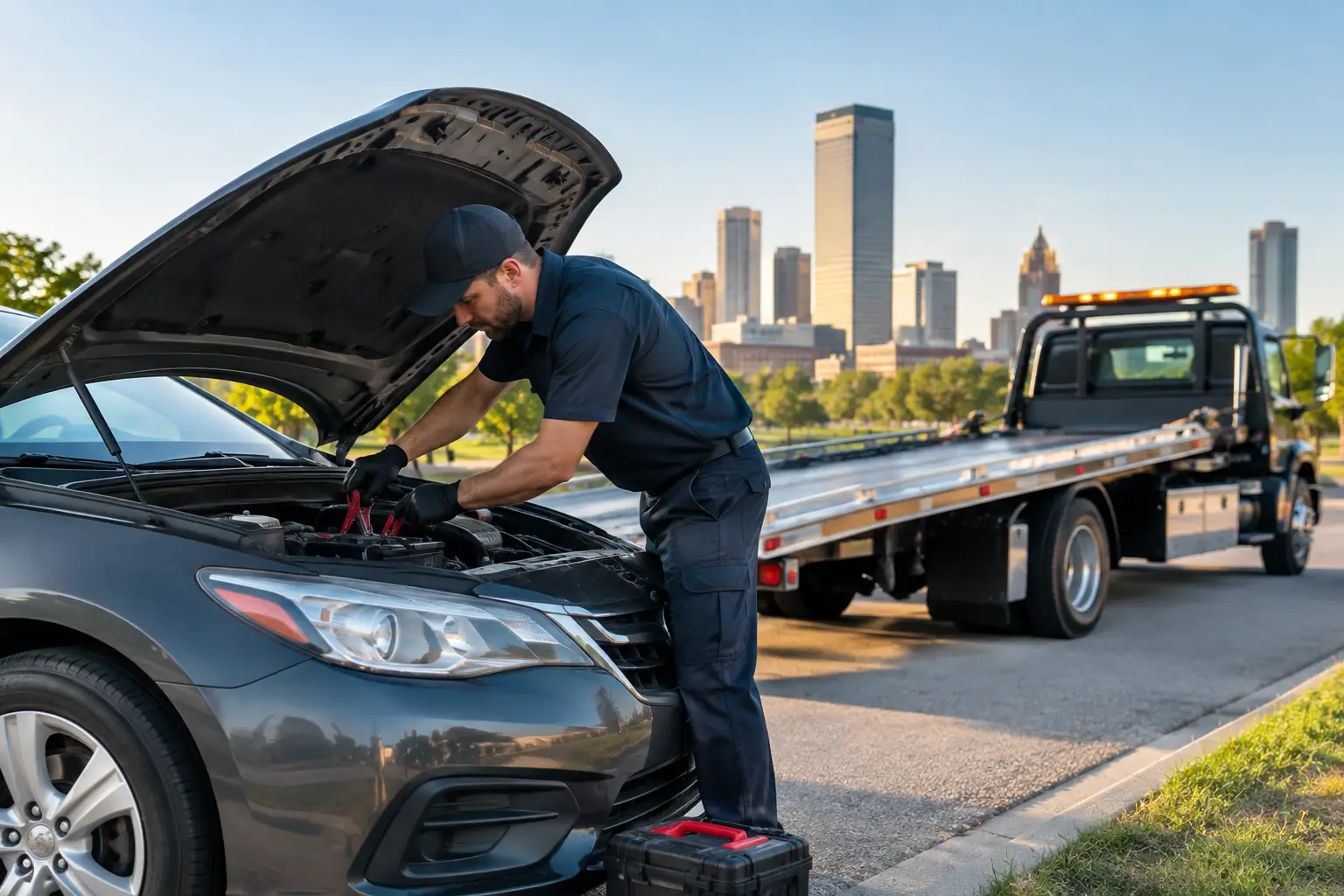
Tulsa Towing handles flatbed transport for disabled vehicles throughout Tulsa and nearby communities, with a focus on clear communication and careful loading. Whether the problem is a dead battery in a driveway, a breakdown near Tulsa Hills, or an accident that leaves the vehicle unable to roll, the first step is the same: tell the dispatcher it is AWD and explain what the vehicle is doing.
When the drivetrain is involved, careful transport is not an extra. It is the sensible way to protect the vehicle you already depend on.