
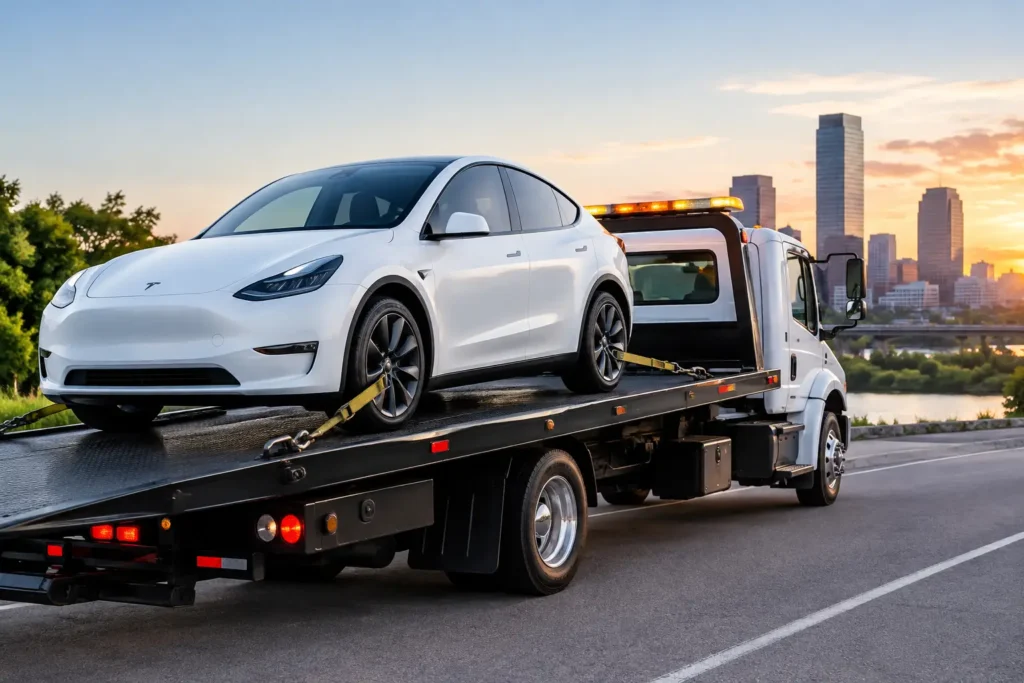
A review of Tesla towing methods starts with one point that matters more than anything else: a Tesla should not be treated like a typical disabled car. When it will not drive, the wrong recovery method can damage the battery area, suspension, drivetrain, or body panels before it ever reaches a repair shop. For a driver stuck in Midtown, South Tulsa, or alongside I-44, that means the tow truck type matters just as much as the response time.
Tesla vehicles are heavy, low to the ground, and built around an electric drive system that needs different handling than a gas-powered vehicle. The safest answer in most roadside situations is a properly equipped flatbed, loaded slowly and secured correctly. There are exceptions based on the model, vehicle condition, and access to the vehicle, but those exceptions require the right equipment and someone who understands why the usual shortcut is not a good idea.
Review of Tesla Towing Methods: What Works
Flatbed towing is the standard choice
A flatbed carries all four tires off the road. That is the main reason it is the preferred method for a Tesla that cannot be driven normally. Nothing is left rolling behind the truck, which helps protect the vehicle’s motors and reduces the chance of contact with uneven pavement, curbs, or road debris.
Flatbed transport also gives the operator better control over a low-clearance vehicle. Loading angles can be managed with ramps, blocks, or proper positioning instead of dragging the front bumper or underbody up a steep deck. This is especially relevant for a Model 3 or Model S, where a rushed approach can turn a simple breakdown into cosmetic or underbody damage.
A flatbed is not automatically damage-free just because it has a bed. The vehicle still needs to be centered, loaded at a controlled angle, and tied down at approved wheel locations. Straps should secure the tires rather than crush suspension parts, body panels, or anything underneath the car. Proper equipment and careful loading are what make flatbed towing the right method.
Transport Mode is part of a safe load
Before a Tesla is winched onto a flatbed, it may need to be placed in Transport Mode. This setting allows the vehicle to roll freely for loading when it is safe and possible to activate it. It is a useful feature, but it does not replace careful recovery work.
Transport Mode may not be available if the vehicle has a completely dead low-voltage battery, collision damage, a screen that will not respond, or another electrical fault. In that situation, a tow operator needs another safe plan rather than forcing the vehicle to move. Wheel dollies, tire skates, and other recovery equipment can be used when appropriate to get a non-rolling Tesla positioned for loading.
The key point is simple: do not assume a Tesla that will not go into gear can be pulled like an ordinary car. The reason it is not moving needs to be considered before any tension goes on the vehicle.
Winching can be safe, but only when done correctly
Most disabled Teslas need to be winched onto the flatbed rather than driven up. That is normal. What matters is where the winch line is attached and how the car is supported while it moves.
Tesla models have specific recovery points and model-specific instructions. A trained operator checks the vehicle’s guidance for the correct tow-eye location or recovery procedure rather than hooking a cable to a suspension arm, wheel, or a convenient-looking piece underneath. Improvised attachment points can bend components or cause damage that is not obvious until later.
The angle of the winch line also matters. With a low vehicle, the operator may need to manage the loading angle and use equipment that prevents the lower bumper or battery shield from scraping. The winch should pull steadily, not jerk the car forward. Slow work is usually faster than repairing damage caused by a rushed load.
Methods That Need Extra Caution
A wheel-lift tow, where two tires stay on the road, is generally not the method to choose for a Tesla. Leaving drive wheels rolling can create serious problems, and leaving any part of a low-clearance EV hanging from a lift adds unnecessary risk. A short tow distance does not make it a safe shortcut.
There are recovery situations where dollies are used with a wheel lift or another towing setup to keep the tires off the pavement and move the vehicle out of a tight location. For example, a Tesla may be trapped in a narrow Downtown parking garage, blocked in at an apartment complex, or positioned where a flatbed cannot immediately line up. That can be a workable recovery method when performed with the right dollies and a clear plan to transfer the vehicle onto a flatbed.
The difference is purpose. Dollies are a controlled tool for a difficult pickup, not a reason to tow the vehicle down the road with improper support. Once access allows, full flatbed transport remains the safer option.
Dragging is another method that should be avoided. If a Tesla will not roll, dragging it across asphalt or pulling it sideways can damage tires, suspension, the lower body, and potentially the undercarriage. A vehicle that is stuck in mud, a ditch, or against a curb needs recovery equipment and a careful assessment before it is moved. This is where a winch-out and a transport job can become two separate parts of the same call.
What Changes the Towing Plan
No two Tesla towing calls are exactly alike. A car with a flat tire in a grocery store lot near Memorial Drive is different from one stopped on US 75 after a warning message, and both are different from a collision scene where the wheels are turned, damaged, or locked.
The towing plan depends on whether the vehicle can enter Transport Mode, whether it rolls freely, its ride height, available space around it, and the condition of the tires and suspension. The destination also matters. A vehicle going to a Tesla service location may have different intake instructions than one being transported to a local collision repair facility or back home for a scheduled repair.
Weather and traffic add another layer. During a hard Tulsa storm or on a busy stretch of Highway 169, the first job is making the scene safe. Once the vehicle is out of the travel lane, the loading process still should not be rushed. Safety for the driver, traffic, and vehicle all need to be handled together.
What Tesla Drivers Should Do Before the Tow Truck Arrives
If the vehicle is in a safe place, take a moment to gather the details that affect the tow. Tell the dispatcher the Tesla model, whether the car is in a garage or parking deck, whether it has collision damage, and whether it rolls. If the screen is working, check whether Transport Mode can be enabled according to the vehicle’s instructions.
Do not try to force the car into Neutral, pull it with another vehicle, or attach a strap underneath because it seems stuck. Avoid parking directly behind the Tesla if it is on a busy road, and move to a safe area away from traffic when possible. If the car is in an unsafe traffic lane, make personal safety the priority over troubleshooting.
It also helps to remove personal items needed for the next few hours before loading begins. A tow may take the vehicle to a repair shop after hours, and access to the car may be limited until the shop opens. Have the destination address ready and tell the operator about low-clearance entrances, gate codes, or a preferred drop-off area.
The Bottom Line for Tesla Transport
The most reliable Tesla towing method is full flatbed transport with proper loading, tire-based securement, and a recovery plan that matches the vehicle’s condition. Transport Mode, wheel dollies, and winching are useful tools, but they have to be used in the right order and for the right reason.
For Tesla drivers in Tulsa, Broken Arrow, Jenks, or Bixby, the practical question is not simply whether a truck can move the car. It is whether the operator has a safe way to load a low-clearance EV without guessing. Tulsa Towing approaches Tesla calls with that standard: assess the vehicle, use the right equipment, explain the plan, and get it where it needs to go without adding another problem to the day.

