
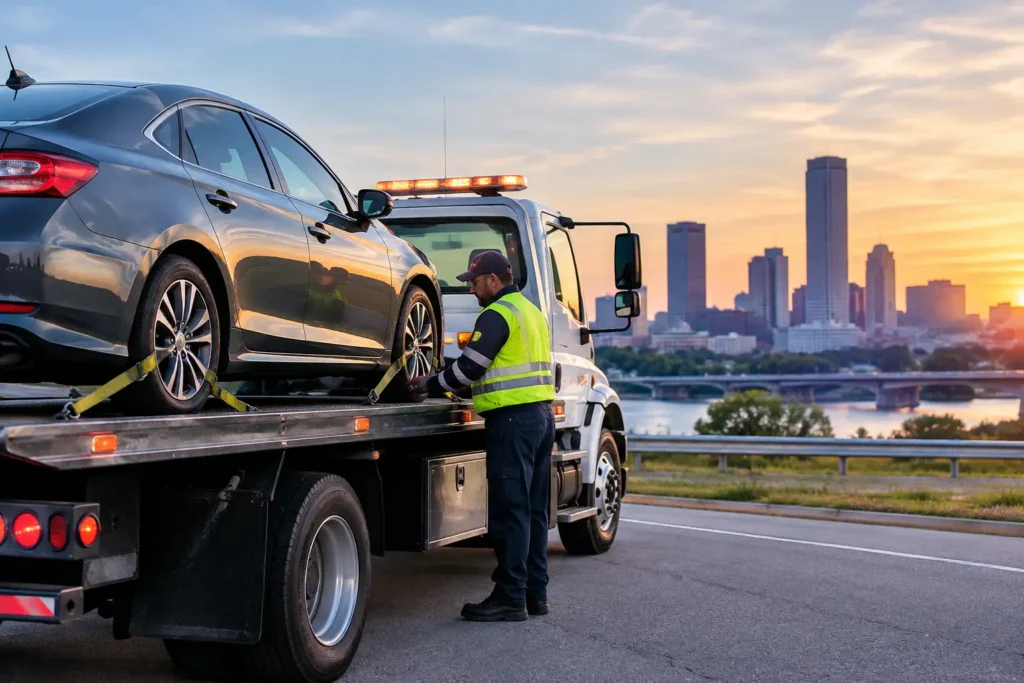
A breakdown on I-44, a dead battery outside a South Tulsa store, or a flat tire near Downtown can turn stressful fast. These Tulsa towing tips are meant for the minutes after your vehicle stops moving: protect yourself first, give clear information when you call, and help make sure your vehicle is moved the right way.
Put Your Safety Ahead of the Vehicle
If your vehicle can still be driven safely, get it out of traffic and into a parking lot, shoulder, or other secure area. Do not keep driving on a flat tire, with overheating warnings, or after an accident just to reach a better spot. A damaged tire can ruin a wheel, an overheating engine can suffer major damage, and a vehicle that has been hit may not be safe to operate.
On busy routes such as US 75, Highway 169, Memorial Drive, and Riverside Drive, space is limited and traffic moves quickly. Turn on your hazard lights as soon as you know there is a problem. If you are on a highway shoulder, stay as far from moving traffic as conditions allow. If it is safer to wait away from the vehicle, move behind a guardrail or to a protected area when one is available.
There is no single rule that fits every roadside situation. In a quiet residential area in Midtown or Broken Arrow, remaining in the locked vehicle may be reasonable while help is on the way. On a narrow highway shoulder with fast traffic, getting to a safer position may be the better choice. Use common sense, watch traffic, and do not stand between your vehicle and the roadway.
If the vehicle is in an active lane, in a dangerous blind curve, or involved in a crash with injuries, call 911 first. A tow truck can move a disabled vehicle, but emergency responders should handle immediate traffic and medical hazards.
Tulsa Towing Tips: Give the Dispatcher Useful Details
A tow truck cannot be sent correctly on a guess. Clear information helps the dispatcher bring the right equipment and plan the safest approach before the truck arrives. Start with your exact location. A nearby business, cross street, highway direction, exit number, or visible landmark is more helpful than simply saying you are “on Memorial” or “near Tulsa Hills.”
Describe the vehicle by year, make, model, color, and whether it is a car, SUV, pickup, or electric vehicle. Mention anything that affects loading: a flat tire, locked steering, missing key, low ground clearance, parking garage height restriction, accident damage, or a vehicle stuck in mud or a ditch.
It also helps to explain what happened. Say whether the car will not start, has overheated, has a flat, was in an accident, or is blocked in. A vehicle that runs but has a failed tire may need a different response than a vehicle with front-end damage and locked wheels. The more accurate the description, the less chance of delay when help reaches you.
Tell the dispatcher where you want the vehicle delivered before the truck arrives. That may be your home, a repair shop, or a dealership. If you have not chosen a destination yet, say so early rather than waiting until the vehicle is loaded. Some repairs can be handled with roadside assistance, while others need a tow, and the right next step depends on the actual problem.
Do Not Assume Every Problem Needs a Tow
A tow is often the safe answer, but not every disabled vehicle needs to be transported. A jumpstart may get you moving if the battery is weak and there are no other warning signs. A lockout can be resolved on site when the keys are inside and the vehicle is otherwise fine. A flat tire may be handled roadside if you have a usable spare, the wheel is not damaged, and the vehicle is parked in a safe place.
The trade-off is safety and the condition of the vehicle. Changing a tire beside highway traffic is not worth the risk. Likewise, a jumpstart is not a full repair if the charging system is failing or the battery is repeatedly dying. If the vehicle starts but warning lights remain on, it overheats, shifts poorly, makes harsh noises, or pulls after a collision, arrange transport instead of hoping it will make it across town.
Winch-out situations need the same judgment. A car stuck in a muddy yard, a ditch, or a slick driveway may look simple from a distance, but angle, ground conditions, and clearance matter. Avoid spinning the tires or repeatedly forcing the vehicle forward and backward. That can dig it deeper, damage the bumper, or create a more difficult recovery.
Prepare the Vehicle for Damage-Free Loading
Once a tow is arranged, there are a few simple things you can do without getting in the way of the loading process. Gather your valuables, medications, work items, garage opener, and anything else you need from the vehicle. If you have the key, keep it available for the operator. Do not leave it on a tire or tucked under a floor mat.
Take a few clear photos of the vehicle from different angles if it is safe to do so, especially after an accident. This is not about expecting a problem. It is simply a practical record of the vehicle’s condition before transport. If there is existing bumper damage, a loose panel, or a special issue with the wheels, point it out during the walk-around.
For most cars, trucks, and SUVs, a flatbed is the preferred option because all four wheels are carried off the ground. This matters even more for all-wheel-drive vehicles, low-clearance cars, and electric vehicles. Improper handling can damage a drivetrain, underbody panel, or wheel. A careful operator will look at the vehicle condition, clearance, and access before deciding how to load it.
Tesla and other EV owners should mention the vehicle type when calling. Electric vehicles have specific lifting and towing considerations, including battery placement and designated lift areas. Do not let anyone guess at where to attach equipment. Proper loading takes a little more attention, and that attention is worth it.
If your vehicle is in a parking garage, apartment lot, or tight downtown space, tell the dispatcher before the truck is dispatched. Clearance, turn radius, and access can affect which truck is appropriate. The same applies to heavy-duty pickups, modified vehicles, and cars parked nose-in against a curb.
Know What to Expect When Help Arrives
A professional tow should not feel rushed or confusing. The operator should confirm the vehicle and destination, assess the condition of the car, explain what needs to happen, and secure it correctly before leaving. If the vehicle cannot be moved safely as it sits, the operator should explain why and what additional recovery steps are needed.
You may be asked to sign an authorization before transport. Read it and make sure the destination is correct. If a repair shop is closed, confirm where the vehicle should be left and whether the shop has after-hours procedures. It is easier to settle those details before the truck pulls away than after your car is at a locked gate.
Ask how you will get updates if you are not riding with the vehicle. In many cases, the customer needs to arrange a ride separately, particularly after a crash or on a highway call. Clear communication matters from dispatch through delivery, especially when a vehicle is headed from Jenks, Bixby, or Broken Arrow into Tulsa for repair.
Tulsa Towing, powered by Neptune Towing, focuses on that straightforward process: assess the situation, use proper flatbed equipment when transport is needed, and get the vehicle to the requested destination without adding unnecessary confusion.
Keep a Small Roadside Plan in Your Phone
Most drivers do not think about towing until they need it. A few notes saved ahead of time can make a bad moment easier. Keep your insurance information, vehicle VIN, preferred repair shop, and an emergency contact accessible on your phone. If your vehicle has a locking lug key, towing eye, or EV-specific instructions, know where those items are stored.
When trouble happens, slow the situation down. Get out of danger, describe the problem clearly, and choose the safer option when the vehicle is questionable. The goal is not to get moving at any cost. It is to get you and your vehicle where you need to be without turning one roadside problem into two.

