A dead battery in a Midtown parking lot does not always mean you need a tow truck. A car sitting low in a ditch near US 75 is a different situation entirely. Understanding vehicle recovery versus roadside help helps you ask for the right kind of assistance, avoid making the problem worse, and get moving with less delay.
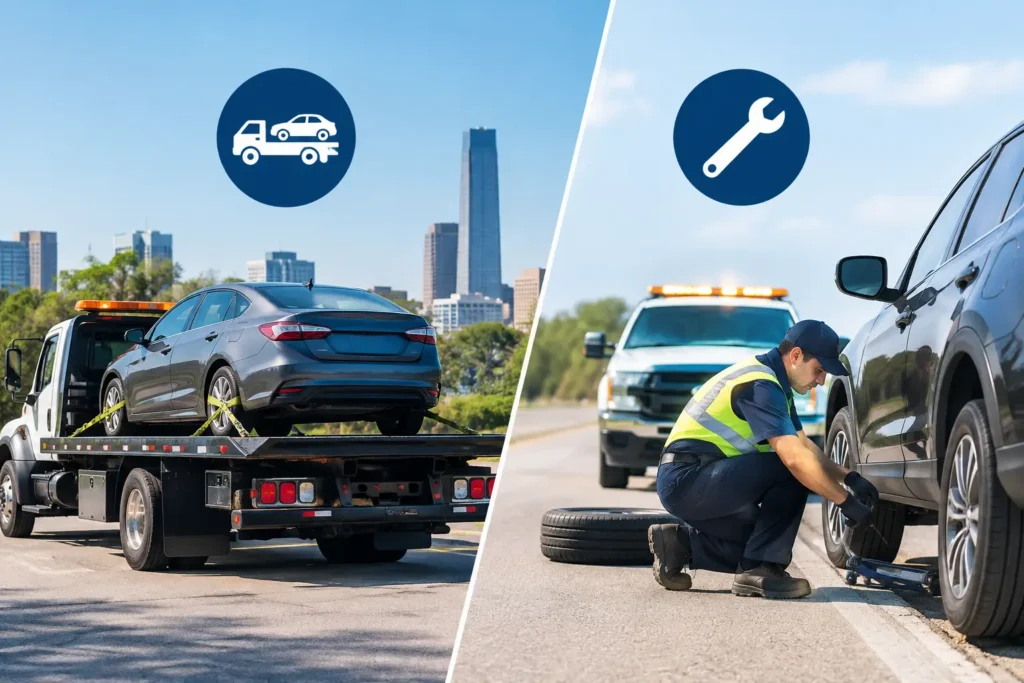
Roadside help is for problems that can usually be corrected where the vehicle sits. Recovery is for a vehicle that cannot safely drive away or cannot be reached and loaded normally. The right answer depends on the condition of the vehicle, where it is located, and whether it can move under its own power without causing damage.
What roadside help is meant to handle
Roadside assistance handles simple, contained problems that leave an otherwise driveable vehicle temporarily stopped. Common calls include a jumpstart for a dead battery, a flat tire change when a usable spare is available, a lockout, or fuel delivery when a driver has run out of gas.
The goal is to solve the immediate issue at the vehicle’s location. If a jumpstart gets the engine running and there are no warning signs, the driver may be able to continue to a repair shop or return home. If a tire is changed correctly and the spare is safe to use, the car can usually be driven carefully for a short distance.
That does not mean every roadside call ends with the vehicle driving away. A jumpstart can reveal a failed alternator. A flat tire may come with a bent wheel or damaged suspension. The service call starts with the simplest safe solution, then changes course if the vehicle is not roadworthy.
For a driver in Brookside, Downtown, or South Tulsa, roadside assistance is often the quickest answer when the vehicle is on level ground, accessible, and safe to work around. Traffic, shoulder space, and the vehicle’s condition still matter. A tire change beside fast-moving traffic on I-44 may not be safe, even if the tire itself is a routine issue.
Vehicle recovery versus roadside help: the practical difference
Vehicle recovery involves moving a vehicle that is stuck, disabled, damaged, or positioned where normal driving is not possible. This can include a winch-out from mud, a ditch, a curb, a steep embankment, or a parking barrier. It can also mean loading a disabled vehicle onto a flatbed after a breakdown or collision.
The key question is not simply, “Can the engine start?” It is, “Can this vehicle move safely without causing more damage?” A vehicle with a broken axle, leaking fluids, deployed airbags, severe tire damage, or a dragging underbody part should not be driven out of the situation. It needs careful handling and transport.
Recovery work also requires more assessment than a standard roadside call. The tow operator needs to consider the vehicle’s angle, traction, clearance, wheel position, nearby traffic, and safe winch points. Pulling a stuck car from the wrong location can damage the bumper, suspension, steering, or frame components. Rushing it can turn a manageable problem into an expensive repair.
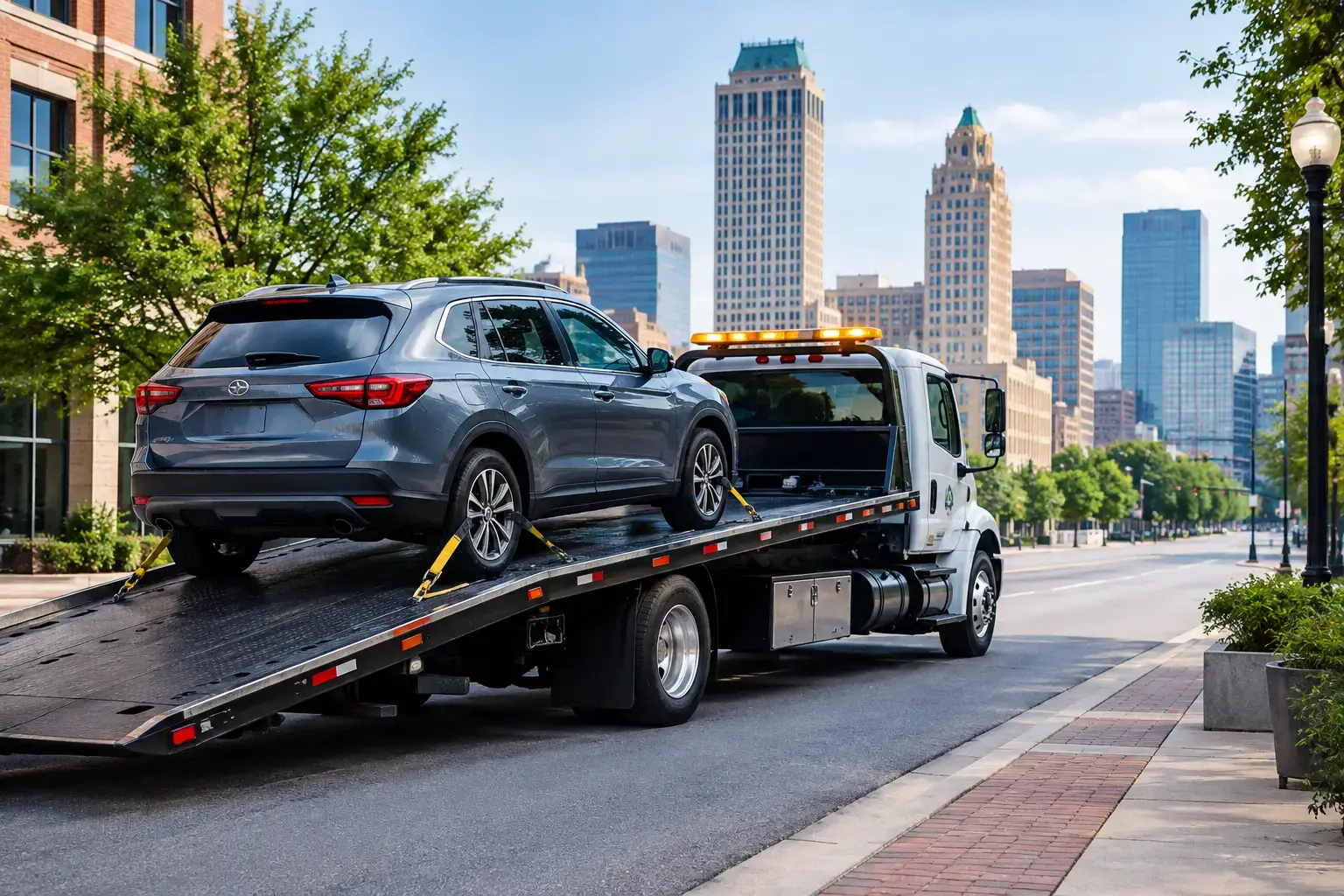
A flatbed is often the right choice once the vehicle is recovered or cannot be driven. It keeps all four wheels off the road and is especially useful for all-wheel-drive vehicles, low-clearance cars, trucks with damage, and electric vehicles. Proper loading matters just as much as the tow itself.
When roadside assistance is usually enough
Roadside help makes sense when the problem has a clear, safe fix and the vehicle has no other condition that prevents driving. A lockout is the obvious example. Once the keys are retrieved without damaging the door or weather stripping, the vehicle can continue normally.
A jumpstart is another common case. If the battery was drained by interior lights or an accessory, the vehicle may start and operate normally afterward. Still, if it dies again quickly, struggles to stay running, or shows charging-system warnings, it is smarter to arrange transport than risk being stranded again in a worse location.
A flat tire can also be a roadside job, but only when the spare is inflated, the wheel hardware is intact, and the car is in a safe place to work. If the tire came apart at highway speed, damaged the fender, or left the wheel bent, a tow is the safer call.
Roadside service is about fixing a small problem without forcing the vehicle to do something it should not do. That is why a good operator looks at the whole situation instead of treating every call the same way.
Signs your vehicle needs recovery or towing
If your vehicle is stuck off pavement, resting against an obstacle, or unable to roll freely, ask for recovery help. Do not keep spinning the tires in mud, grass, gravel, or a slick ditch. Spinning can dig the vehicle deeper, overheat components, and make the extraction more difficult.
Towing is generally the better choice after an accident, when the steering feels wrong, when a wheel is pushed out of position, or when the vehicle has a major fluid leak. The same applies if the vehicle overheats, loses power repeatedly, will not shift properly, or has warning lights that point to a serious issue.
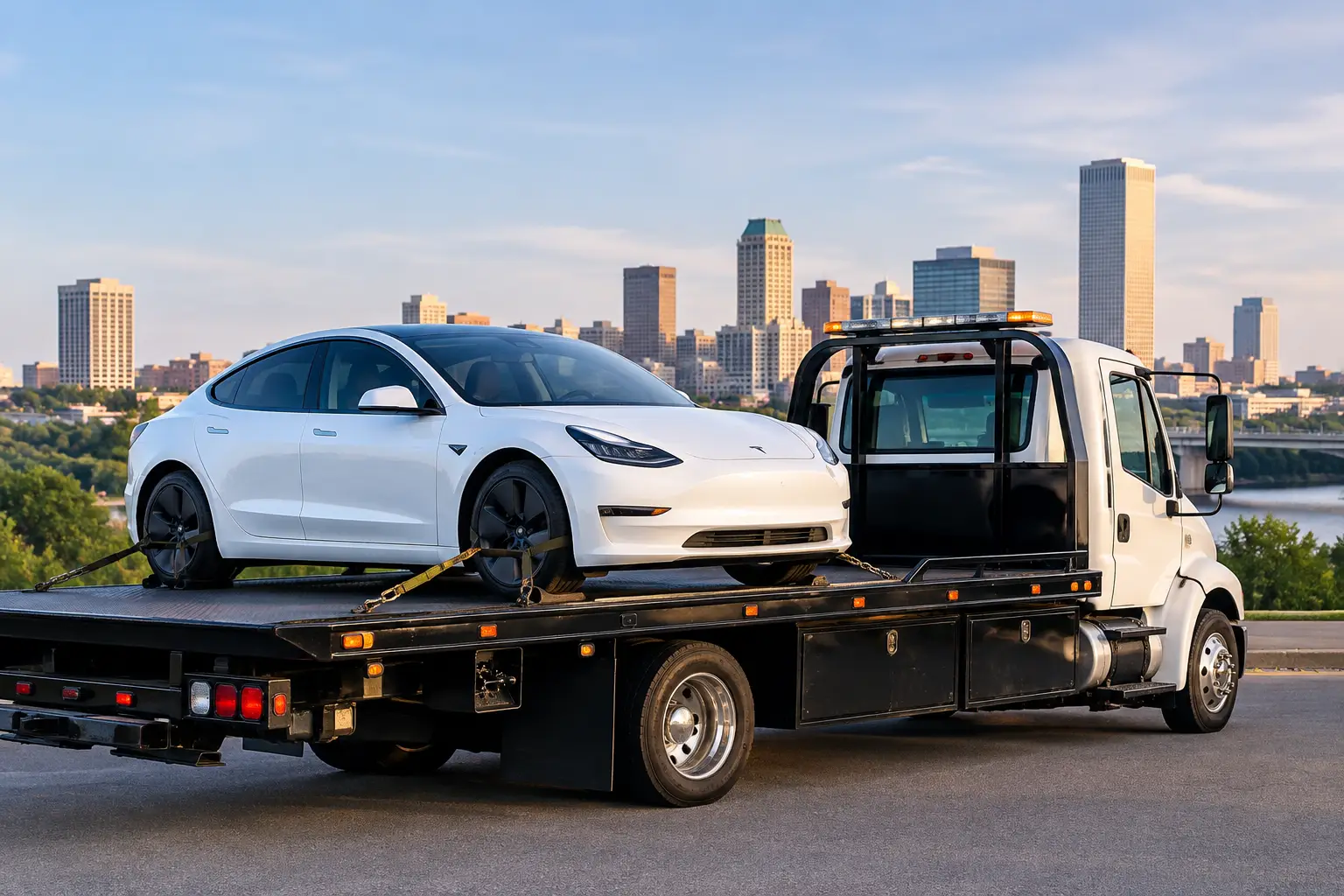
Electric vehicles deserve extra care. A Tesla or another EV may look fine after a breakdown, but improper towing can damage the drive system or underbody battery area. A flatbed and the correct loading approach protect the vehicle during transport.
Low-clearance vehicles need the same attention. A steep driveway, parking garage ramp, or broken suspension part can make a standard approach risky. The equipment and loading angle need to match the vehicle, not the other way around.
What to tell the dispatcher before help arrives
Clear details help send the right equipment the first time. Explain whether the vehicle is on a road, a highway shoulder, a parking garage, a driveway, or off the pavement. Mention if it is stuck in mud, against a curb, in a ditch, or involved in a collision.
Describe the vehicle accurately, including whether it is a truck, an all-wheel-drive model, an EV, or a low-clearance car. Let the dispatcher know if the wheels turn, whether the keys are available, and whether the vehicle is leaking fluid or has visible damage.
Your exact location matters, especially around large Tulsa corridors such as Memorial Drive, Riverside Drive, Highway 169, and US 75. A nearby cross street, business name, or direction of travel can save time when you are on a highway or in a large shopping area. If you are in Jenks, Bixby, Broken Arrow, or Glenpool, say so upfront so availability and routing can be confirmed clearly.
Do not turn a roadside problem into a recovery job
Many drivers try to power through because they only need to get a few more miles. That can work with a minor issue, but it is a bad gamble when the vehicle is already showing signs of damage. Driving on a shredded tire can ruin a wheel. Trying to move with a damaged suspension can make the vehicle harder to load and more costly to repair.
The same applies to a stuck vehicle. Avoid attaching straps to a bumper, hitching to an unknown point, or having another driver yank the vehicle free. Recovery points are not interchangeable, and a strap under tension can be dangerous if it breaks or comes loose.
If the vehicle can be fixed safely on site, roadside assistance keeps things simple. If it cannot, a careful recovery and flatbed tow protect the vehicle and get it to the repair shop or dealership without adding unnecessary damage.
When you are unsure which service you need, describe what happened instead of guessing the solution. A clear explanation of the vehicle’s condition and location gives the operator what they need to make the safe call and get you out of a stressful spot.