
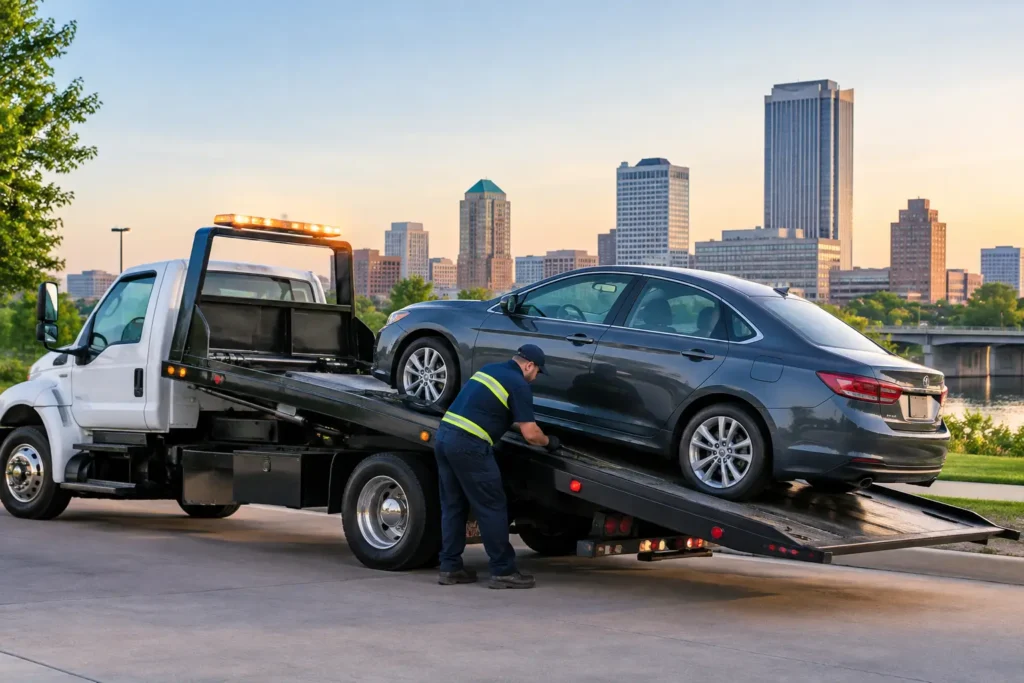
A dead battery at an apartment complex is different from a dead battery in your driveway. There may be assigned spaces, narrow drive lanes, gate codes, speed bumps, parked cars on both sides, and neighbors trying to get home from work. This South Tulsa apartment towing guide explains what to do when your vehicle will not move and you need help without creating more problems for yourself or the property.
Whether you are near Riverside, Memorial, Tulsa Hills, or a newer apartment community off 121st Street, the first goal is simple: keep the vehicle and the access lane safe while you arrange the right kind of help.
Start by deciding whether you need roadside help or a tow
Not every apartment parking lot problem requires a tow truck. If the issue is a weak battery, a flat tire, or locked keys, roadside assistance may get you moving where you are. That is usually the easier option when your vehicle is safely parked and there is enough room to work around it.
A tow is the right call when the vehicle will not start after a jump attempt, has mechanical damage, is overheating, has a wheel or suspension issue, or cannot be driven safely. If it was involved in an accident, do not try to move it just because it is blocking part of the lot. A loose bumper, damaged wheel, or leaking fluid can turn a short move into a more expensive repair.
Electric vehicles need an extra level of care. A Tesla or other EV that will not drive should not be handled like a standard front-wheel-drive car. Proper loading and flatbed transport protect the drivetrain and battery area. The same applies to low-clearance cars that can scrape on steep driveways or speed bumps before they ever reach the truck.
Make the vehicle easy to find in a South Tulsa apartment lot
Apartment addresses can be misleading, especially in larger communities where building numbers are set back from the main entrance. Before help arrives, have the exact building number, your parking space number if you have one, and the closest entrance or gate ready.
If the complex uses a coded gate, tell the towing operator up front. Do not assume a driver can get through by following another vehicle. Some properties have separate resident and visitor entrances, and the wrong entrance can add time when you are already stuck.
If it is safe to do so, turn on hazard lights. At night, use the flashlight on your phone or stand where the truck can see you when it enters the property. This matters most in lots with several buildings, covered parking, or limited visibility around corners. Clear directions save time and prevent a tow truck from making unnecessary passes through a crowded property.
If your vehicle is parked in a garage, beneath a carport, or at the end of a tight row, mention that during the call. Height clearance, turning room, and the angle needed to load the vehicle all affect how the job is handled. A careful operator needs the full picture before arriving, not after.
Do not block the recovery area
Once a truck is on the way, give it room to work. A flatbed needs space to line up with the disabled vehicle, lower the bed, and load it at a controlled angle. In a packed apartment lot, that may mean moving a second household vehicle out of the lane or asking a neighbor not to park directly in front of the disabled car for a few minutes.
Avoid trying to push a disabled vehicle into a different spot unless it is creating an immediate safety hazard and you can do so without risk. Steering can lock, brakes may not respond normally with the engine off, and a vehicle on a slope can move faster than expected. Let the operator assess the safest loading position when possible.
Know the difference between a parking dispute and a disabled vehicle
Apartment parking rules can be strict. Assigned spaces, guest permits, fire lanes, and garage access areas are managed by the property. If you are concerned about where your disabled vehicle is sitting, notify the leasing office, after-hours maintenance line, or property contact as soon as you can.
Keep the conversation clear: your vehicle is disabled, help has been arranged, and you can provide the estimated arrival information if asked. That is more useful than leaving the situation unexplained, particularly if the car is near a dumpster lane, gate, or another area that needs to stay open.
Do not assume a vehicle with a mechanical problem is safe to leave for several days because it has not moved. Every property has its own parking agreement and enforcement process. If repairs will take time, ask management where the vehicle may remain temporarily or arrange transport to a repair shop, dealership, or another approved location.
This is also a good reason to keep your registration, insurance information, and apartment parking permit current and accessible. It will not fix a breakdown, but it can make a conversation with property staff much simpler when you are trying to resolve a problem after hours.
Choose the destination before the truck arrives
When a car cannot be driven, the fastest decision is not always the best one. Think about where the vehicle needs to go before the truck is at the curb. A local repair shop may be the right destination for an older vehicle with a starting or cooling issue. A dealership can make more sense for a newer vehicle, a warranty concern, or an EV that needs brand-specific diagnosis.
Ask yourself a few practical questions. Is the shop open when the vehicle will arrive? Do they accept after-hours drop-offs? Is there a designated place to leave keys? If the answer is no, you may need to arrange a different destination or wait until the shop can receive the vehicle.
For some drivers in South Tulsa, getting the vehicle from an apartment near 71st and Yale to a repair facility across town is straightforward. For others, a nearby shop in Jenks, Bixby, or Broken Arrow may be more convenient. The right destination depends on where your trusted repair option is located, shop hours, and the vehicle’s condition.
If the vehicle is being towed after an accident, take photos of the damage and remove personal belongings before loading if it is safe. Check the glove box, center console, trunk, and any cargo area. Once the car is dropped off, you may not be able to access it until the shop opens.
What a careful apartment-complex tow looks like
Apartment towing requires more than attaching a vehicle and pulling away. The operator needs to consider curbs, drainage dips, tight corners, speed bumps, overhead branches, and nearby vehicles. That is why proper flatbed equipment is often the safest choice for a disabled car, truck, or EV.
A careful load protects low front bumpers, wheels, and underbody components. It also avoids unnecessary movement when a car has drivetrain damage or a locked wheel. If the vehicle is in a difficult position, the operator may need to reposition the truck, use the right recovery equipment, or take extra time to create a safe angle. That is not wasted time. It is how damage gets avoided.
Be direct about anything unusual with the vehicle. Mention if it is all-wheel drive, electric, lowered, has a flat tire, has been in a collision, or cannot shift into neutral. Those details change the loading plan. They also help prevent a rushed decision in a crowded lot.
Tulsa Towing, powered by Neptune Towing, focuses on roadside help and damage-free transport for drivers who need to get a disabled vehicle to the right place. The work is simple in principle: assess the situation, use proper equipment, communicate clearly, and move the vehicle safely.
Keep your next apartment breakdown from becoming a bigger problem
Apartment lots add a few complications, but they do not have to turn a breakdown into a long night. Save your exact building address and gate instructions in your phone. Keep your repair shop or dealership information handy. If you have an EV or a low-clearance vehicle, know that it may require specific loading procedures.
Most importantly, do not let urgency push you into unsafe choices. Give the towing operator accurate details, make room when you can, and choose a destination that can actually receive your vehicle. A few clear details at the start help get your car out of the lot and on its way without adding damage, confusion, or another problem to handle.

