
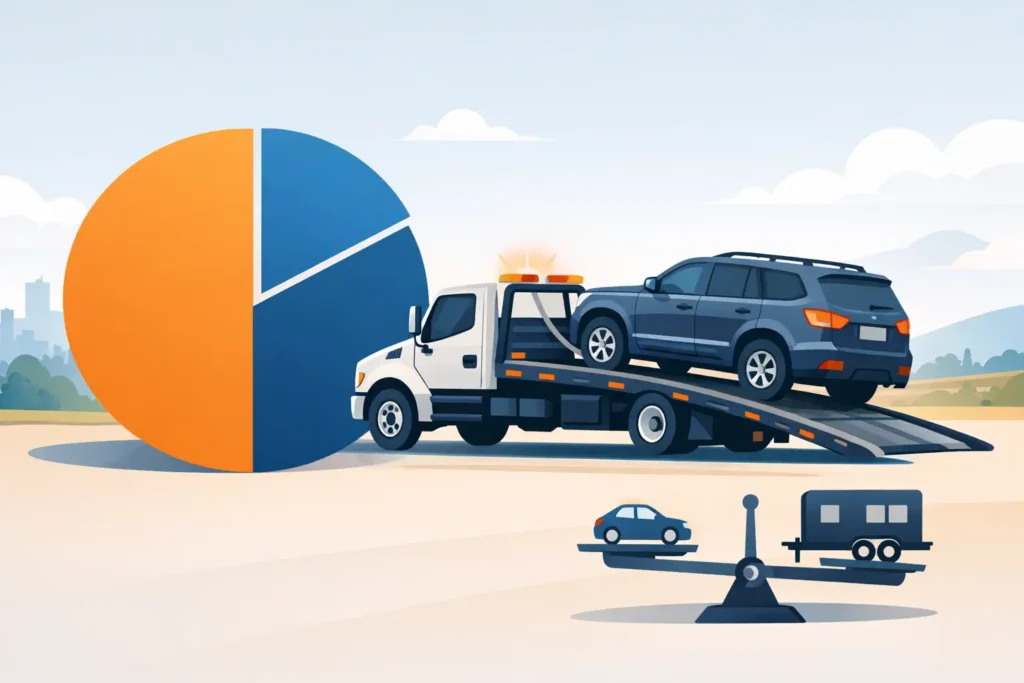
A trailer can be under a truck’s published tow rating and still feel unstable, slow to stop, or hard on the equipment. That is why drivers ask, what is the 80/20 rule for towing? It is a practical safety guideline that says many people should plan to tow no more than about 80% of their vehicle’s maximum rated towing capacity, especially when the trip involves passengers, cargo, hills, highway speeds, or longer distances.
It is not a law, and it does not replace the ratings in your owner’s manual. Think of it as working margin. That remaining 20% gives the tow vehicle, hitch, brakes, tires, and driver more room to handle real conditions instead of operating right at the edge of the numbers.
What Is the 80/20 Rule for Towing?
The 80/20 towing rule means taking the maximum trailer weight your vehicle is rated to pull and using 80% of that figure as a more comfortable planning limit.
For example, if a pickup is rated to tow 10,000 pounds, 80% is 8,000 pounds. A driver following this guideline would look for a trailer with a fully loaded weight at or below 8,000 pounds, not simply an empty trailer that weighs 8,000 pounds before gear is added.
The rule exists because manufacturer tow ratings are usually maximum ratings under specific conditions. The vehicle may have a particular engine, axle ratio, factory towing package, properly working trailer brakes, and limited passenger or cargo weight. Real towing is rarely that simple. Add four people, a bed full of tools, a cooler, fuel, recovery gear, or a steep grade, and the margin gets smaller fast.
A vehicle rated for a certain number does not suddenly become unsafe one pound below it. But towing at the limit leaves less room for crosswinds, emergency braking, heat, poor pavement, and loading mistakes. The 80% figure is a conservative way to account for those variables.
Start With Loaded Weight, Not the Trailer’s Empty Weight
The most common mistake is using dry weight, sometimes called unloaded vehicle weight, to decide whether a trailer is suitable. Dry weight can be useful for comparison shopping, but it is not the weight being pulled down the road.
Loaded trailer weight includes the trailer itself plus everything inside or on it. A utility trailer carrying a vehicle, a camper with water and supplies, or an equipment trailer loaded with tools can gain hundreds or thousands of pounds quickly. Fuel, batteries, propane, cargo, and aftermarket accessories all count.
If a trailer has a dry weight of 6,500 pounds and a maximum loaded weight of 9,000 pounds, plan around what it will actually weigh on travel day. If you regularly haul a 7,800-pound load with a vehicle rated at 9,000 pounds, you are technically under the rating. Still, you are at roughly 87% of capacity before considering whether the vehicle’s payload and hitch limits are also being exceeded.
The best answer comes from a scale. Weigh the tow vehicle and loaded trailer together, then compare the real numbers with the labels and ratings for the vehicle, trailer, tires, hitch, and axles. Guessing based on how the trailer looks or feels is not a safe substitute.
A Quick 80% Calculation
Take the vehicle’s maximum tow rating and multiply it by 0.80. A vehicle rated for 7,500 pounds has an 80% planning figure of 6,000 pounds. One rated for 12,000 pounds has a planning figure of 9,600 pounds.
That calculation is simple, but it is only one part of setting up a safe tow. A truck can have enough towing capacity and still run out of payload capacity. This is especially common with half-ton trucks, SUVs, and family vehicles carrying several passengers.
Tow Rating Is Not the Only Number That Matters
The 80/20 rule can be helpful, but it does not override any lower rating. The lowest applicable rating is the one that controls the job.
Your vehicle’s payload rating matters because trailer tongue weight sits on the tow vehicle. With a conventional bumper-pull trailer, tongue weight commonly falls around 10% to 15% of loaded trailer weight. A 7,000-pound loaded trailer may place 700 to 1,050 pounds on the hitch before counting people, pets, tools, or anything in the cab or truck bed.
That tongue weight also affects rear axle weight and tire load. If the rear of the vehicle squats heavily, steering can become light and braking performance can suffer. A properly rated weight-distribution hitch may help on certain conventional trailer setups, but it must be compatible with the vehicle, trailer, and hitch receiver. It is not a fix for exceeding a rating.
Gross combined weight rating is another limit to check. This is the maximum allowed weight of the loaded tow vehicle and loaded trailer combined. Trailer axle ratings, hitch ratings, and tire load ratings also matter. A trailer’s brakes must be in good condition and correctly adjusted, since the tow vehicle should not be doing all the stopping on its own.
When the 80% Rule Makes the Most Sense
The rule is especially useful for drivers who tow occasionally or who are selecting a vehicle and trailer combination for the first time. It provides room for the everyday factors that can make towing more demanding than expected.
A comfortable 80% setup may be appropriate for a family pulling a camper through changing weather, a contractor carrying equipment, or a driver who expects highway travel and hills. It is also sensible when the tow vehicle will be loaded with passengers and gear, rather than driven by one person with an empty cargo area.
Some experienced drivers may safely operate closer to a properly established maximum rating when every part of the setup is correct and conditions are controlled. That does not make the 80/20 rule wrong. It just means towing capacity is not a single universal number. Vehicle configuration, trailer type, load balance, road conditions, driver experience, and maintenance all change the picture.
The rule should be treated as a planning cushion, not permission to ignore the manufacturer’s instructions or a reason to assume every 80% combination will work.
Load Balance Can Matter as Much as Total Weight
A trailer that is within the right weight range can still be unsafe when loaded poorly. Too little tongue weight can allow sway. Too much tongue weight can overload the rear of the tow vehicle and reduce steering control.
Heavy cargo should generally be kept low and positioned so the trailer carries proper tongue weight without exceeding the hitch, axle, or payload limits. Secure every item. A load that shifts during a hard brake or lane change can alter the way the trailer tracks behind the vehicle.
Before leaving, check that the coupler is fully latched, safety chains are properly crossed and connected, the breakaway cable is attached correctly, lights work, tires are inflated to the listed pressure, and the trailer brakes respond as they should. These checks take minutes and can prevent a much bigger problem later.
Road Conditions Change the Margin You Need
The same trailer can handle very differently on a calm, dry morning than it does during heavy rain, crosswinds, rush-hour traffic, or a long downhill grade. That is another reason the 80% rule is useful. It leaves more room when conditions are less than ideal.
Around Tulsa, highway traffic on I-44, US 75, and Highway 169 can change quickly. Merging, sudden stops, construction zones, and wind are harder to manage with a trailer that is pushing the tow vehicle to its limit. Slow down, leave a longer following distance, and avoid sharp steering inputs. If sway starts, do not try to steer aggressively out of it. Ease off the accelerator, keep the wheel steady, and apply trailer brakes manually only if your brake controller instructions allow it.
If a vehicle and trailer are already overloaded, improperly balanced, or damaged, the safe answer may be not to continue towing. A flatbed tow can prevent further damage and get the vehicle or equipment where it needs to go without adding a roadside hazard.
The Practical Takeaway Before You Hitch Up
Use the 80/20 rule as a conservative starting point: aim for a loaded trailer weight around 80% of the vehicle’s maximum tow rating when possible. Then verify the rest of the setup, including payload, tongue weight, combined weight, hitch capacity, tires, brakes, and load balance.
If the numbers are close, do not rely on a guess or an empty-weight brochure. Get the loaded combination weighed and make decisions from the real weight. A little capacity left in reserve is usually worth far more than squeezing one more load onto a setup that is already working at its limit.