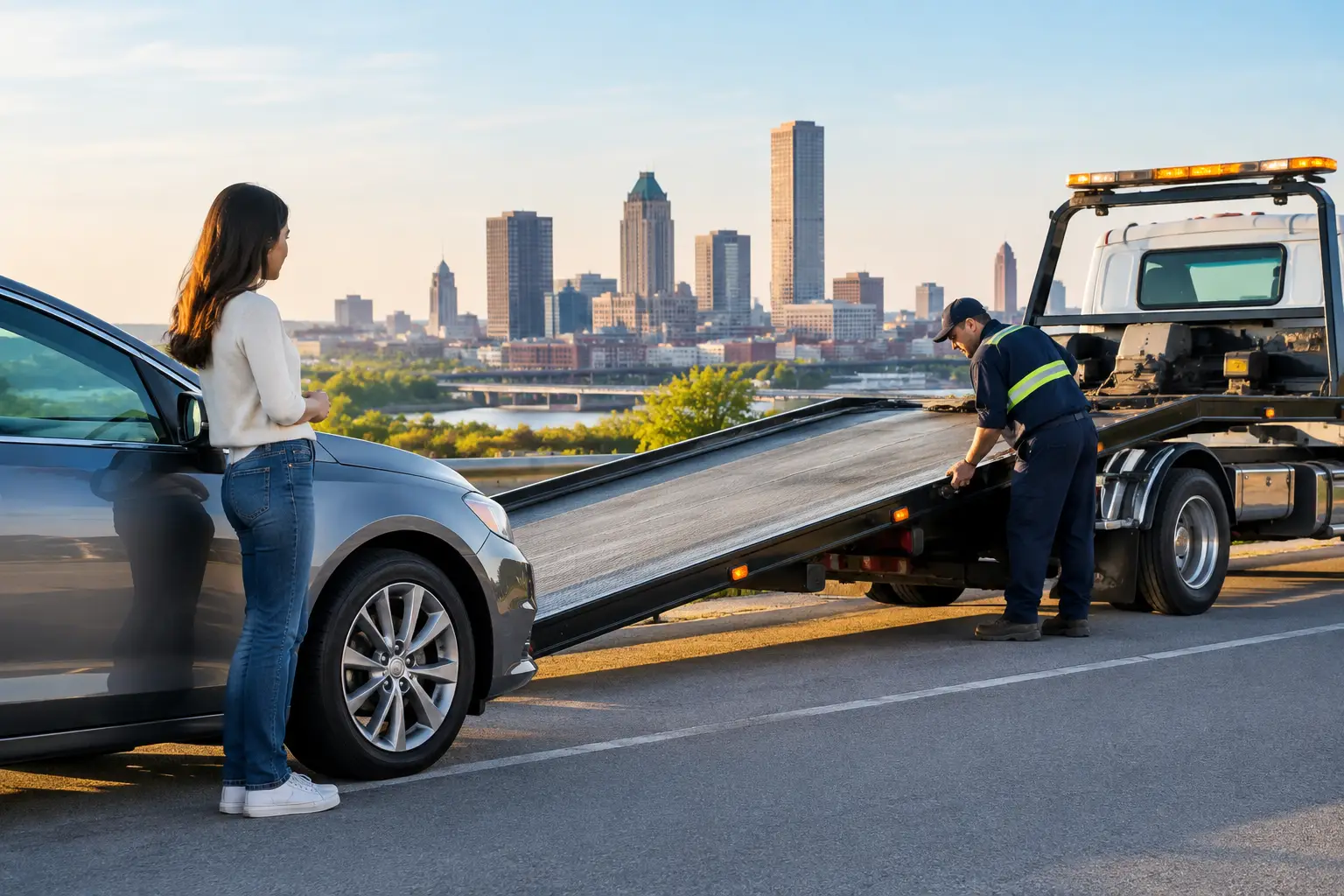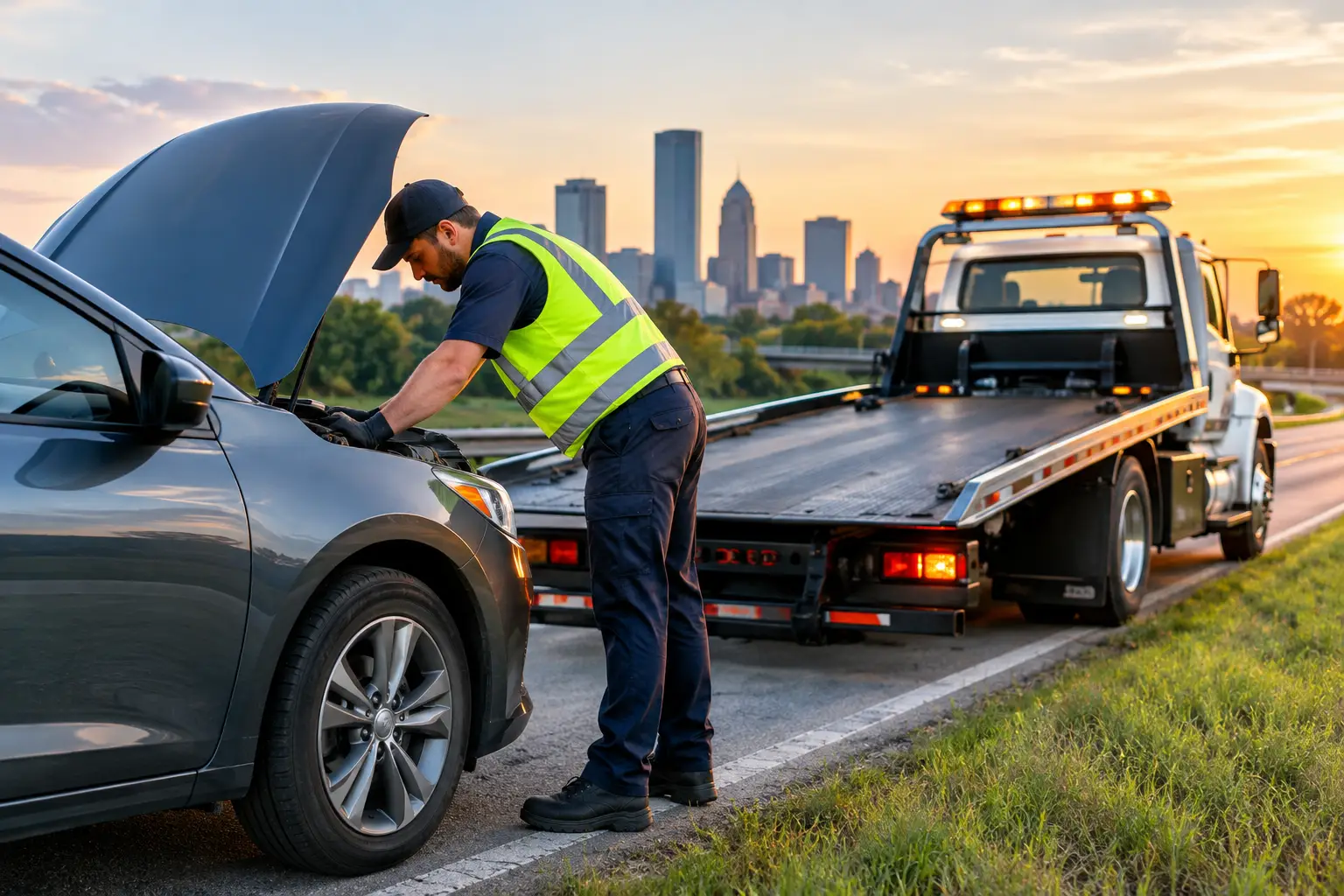
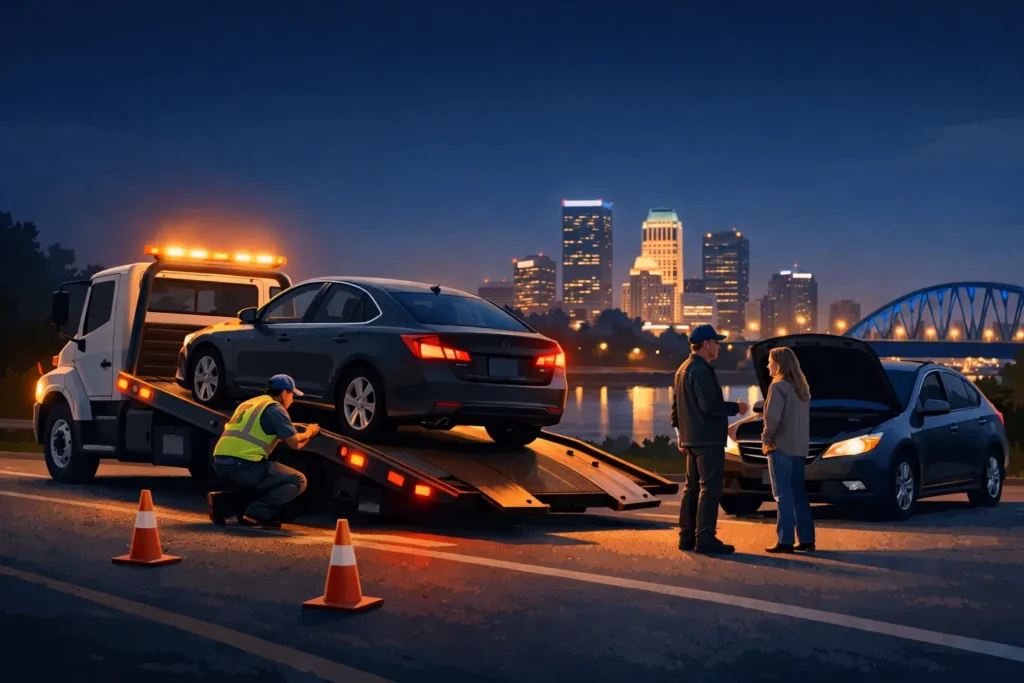
A dead battery in a dark parking lot feels different than one in your own driveway. So does a flat tire on I-44, a lockout at a gas station, or an engine that quits on Memorial after the traffic has thinned out. This example of roadside help at night shows what a safe response should look like, what can be handled on site, and when the right move is to tow the vehicle.
The situation: a vehicle will not start after dark
Picture a driver leaving work in South Tulsa around 10 p.m. The vehicle clicks once and the dashboard lights dim. They are parked under one working light, a few rows away from the entrance. It could be a weak battery, loose connection, or a charging problem. From the driver’s seat, there is no need to guess.
The first job is getting the vehicle and the people in it into a safer position. If the vehicle is already parked and out of traffic, the driver should stay inside with the doors locked while arranging help, especially if the lot is quiet. If it is stopped on a road shoulder, hazard lights should be on right away. Move as far from moving traffic as the vehicle can safely go, but do not walk along a highway lane trying to find a better spot.
When roadside help arrives, the technician checks whether a jumpstart is appropriate. A proper jump is more than connecting cables and hoping for the best. The battery condition, terminal connections, and vehicle type matter. Newer cars have sensitive electronics, and electric vehicles have separate 12-volt systems that should be handled according to the vehicle’s setup.
If the vehicle starts and stays running normally, the driver may be able to get home or directly to a repair shop. If it starts but immediately dies, displays warning lights, or has an obvious electrical issue, a tow is usually the safer call. A jumpstart gets the engine running. It does not repair a failed alternator, damaged battery cable, or charging-system problem.
What roadside help at night should focus on
Night calls are not just daytime calls with less light. Visibility is lower, traffic can move faster on open roads, and a driver may be stranded in an unfamiliar area. The service needs to begin with a clear location, a clear description of the problem, and honest communication about whether it can be solved roadside.
For a flat tire, that may mean installing a usable spare if the vehicle has one and the wheel can be changed safely. A spare with low air, damaged lug nuts, a seized wheel, or a vehicle sitting too close to traffic can change the plan. In those cases, loading the vehicle onto a flatbed is often safer than trying to force a tire change on the shoulder.
For a lockout, the goal is simple: gain entry without damaging the door, glass, weather stripping, or lock mechanism. Modern vehicles can be more complicated than they look. A rushed attempt can turn a locked car into a repair bill, which is why the right tools and method matter.
A winch-out is another common nighttime situation, especially after rain. A vehicle can slide off a driveway, get stuck in a muddy lot, or lose traction near a curb. The vehicle may look close to the road but still be positioned badly for a quick pull. The operator needs to assess the ground, recovery points, traffic, and angle of the pull before moving anything.
An example roadside help at night call on a busy road
A more urgent example roadside help at night call might happen on US 75. A driver notices a tire losing pressure, pulls onto the shoulder, and the vehicle settles lower as trucks pass nearby. The driver has a spare, but the shoulder is narrow and the traffic lane is only a few feet away.
This is not a good place for the driver to start removing lug nuts. Hazard lights should remain on, passengers should stay in the vehicle when it is safe to do so, and the driver should give the dispatcher the closest exit, direction of travel, vehicle color, and any nearby landmark. Saying “near downtown” is less useful than saying “southbound US 75 just past the 71st Street exit.”
Once on scene, roadside assistance may be possible if there is enough room to work safely. If there is not, the vehicle should be moved by flatbed rather than repaired in an exposed traffic position. That decision is not overkill. A simple flat tire becomes a dangerous situation when people are working beside fast-moving vehicles in poor visibility.
The same judgment applies on I-44, Highway 169, Riverside Drive, and other Tulsa routes where traffic conditions can change quickly. The fastest solution is not always the safest one. Getting the vehicle loaded properly and taken to a tire shop, home, or repair facility may take a little more time than a roadside repair, but it removes the driver from a vulnerable spot.
What to do while waiting for help
The wait is usually the part that feels longest. A few practical steps can make the situation safer and make dispatch easier.
Keep your phone charged if possible, and send your exact location to a family member or friend. If you are on a roadway, turn on hazards and keep interior lights low so you can see outside without creating glare. Do not stand behind or in front of the vehicle, particularly on a slope or shoulder.
If you must leave the vehicle because of an immediate safety concern, move well away from traffic and behind a barrier when one is available. Do not sit in the path of a disabled vehicle or lean against it. On a busy highway, visibility and distance matter more than staying close to the car.
Have the basic details ready when you call: the vehicle year, make, model, location, problem, and destination if towing is likely. Mention special conditions such as a low-clearance car, electric vehicle, heavy-duty pickup, parking garage, or a vehicle that is stuck off pavement. Those details help ensure the right equipment is dispatched instead of creating delays after the truck arrives.
When a tow is the better answer
Roadside assistance is useful when the problem can be solved safely where the vehicle sits. A jumpstart, lockout service, tire change, or minor winch-out can get a driver moving without a tow. But there are times when trying to drive away creates a bigger problem.
A tow makes sense when the vehicle overheats, has accident damage, loses a wheel, will not stay running, has a flashing warning light, or cannot be moved without risk. It is also the right call when a vehicle is stopped in a location where roadside work would expose the driver or technician to traffic.
Flatbed transport is especially useful for low-clearance vehicles, all-wheel-drive vehicles, electric vehicles, and cars with damage that affects steering or suspension. The vehicle stays off the ground during transport, which avoids unnecessary wear and reduces the chance of additional damage. Careful loading matters just as much in a parking garage or apartment complex as it does on a highway shoulder.
Clear communication makes a nighttime call easier
A good nighttime roadside call should not leave the driver wondering what happens next. The dispatcher should confirm the location, explain whether roadside service or towing is likely, and let the driver know what information is needed. Once the truck arrives, the operator should explain the plan before starting work.
That matters when the vehicle is a daily driver, a family vehicle, or a newer EV that the owner does not want handled carelessly. The job is not simply moving a car. It is getting it out of a difficult situation without adding damage, confusion, or unnecessary stress.
If you are stuck after dark in Tulsa, Jenks, Bixby, or Broken Arrow, focus first on getting yourself out of danger and giving an accurate location. Tulsa Towing, powered by Neptune Towing, handles roadside problems and damage-free flatbed transport with that same practical approach. At night, the right help is the help that gets you safely off the road and pointed toward the next step.