
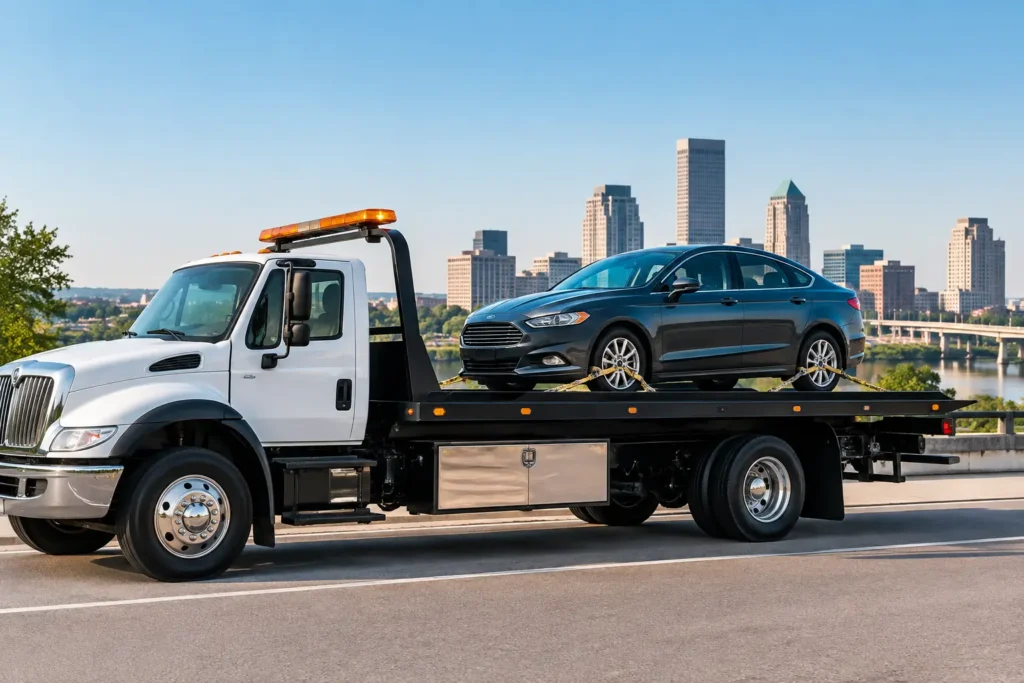
A dead vehicle on I-44, a fender-bender near Midtown, or a car that will not start in a South Tulsa parking lot creates the same immediate question: how do you get it moved without making the problem worse? The five benefits of professional flatbed service matter because a flatbed carries the entire vehicle off the road instead of pulling it with two wheels still rolling.
For many breakdowns, that is the safest and most practical way to move a car, truck, SUV, or EV to a repair shop, dealership, or home. The right truck is only part of the job. Proper loading, securement, clearance checks, and clear communication are what protect the vehicle from pickup to drop-off.
1. Professional Flatbed Service Helps Prevent Added Damage
With flatbed towing, all four tires are loaded onto the truck deck. Nothing is left rolling behind the tow truck. That reduces the risk of damage that can happen when a disabled vehicle is pulled while it has a drivetrain issue, wheel damage, steering trouble, or an unknown mechanical problem.
This matters after an accident. A vehicle may look driveable at first glance, but a bent suspension component, damaged wheel, leaking fluid, or loose bumper can make moving it on its own wheels a bad idea. A professional operator checks the vehicle’s condition before loading and chooses a safe approach rather than treating every call the same.
Damage prevention also comes down to the loading angle. Low-clearance cars can scrape when loaded carelessly. A flatbed can be positioned and operated to reduce that angle, with the vehicle guided onto the deck carefully. For a driver already dealing with a breakdown, avoiding fresh damage during the tow is a real benefit.
2. It Is Safer for Electric Vehicles and All-Wheel Drive Vehicles
Electric vehicles, all-wheel drive vehicles, and many modern cars have towing requirements that should not be ignored. In many cases, the vehicle needs to be transported with all wheels off the ground. Flatbed service meets that need without forcing the vehicle’s wheels to turn while it is being towed.
That is especially relevant for Tesla and other EV owners. EVs have high-voltage systems, specific towing guidance, and battery packs that require careful handling. The vehicle may also be completely unresponsive after a dead 12-volt battery or collision. A trained operator can account for its weight, ground clearance, towing mode requirements when applicable, and safe loading points.
The same principle applies to all-wheel drive cars and trucks. Towing one improperly can put stress on drivetrain components. A flatbed avoids that issue by transporting the vehicle as a complete unit. It is not about using complicated language or making the situation sound worse than it is. It is about using the right method for the vehicle in front of you.
3. Flatbed Towing Works When the Vehicle Cannot Roll Normally
Some towing jobs are straightforward: the car starts, the tires are intact, and it can be placed in neutral. Others are not. A flat tire, locked wheel, broken axle, seized engine, damaged steering, or collision damage can leave a vehicle unable to move normally.
A professional flatbed service is built for those situations. Depending on the condition of the vehicle and the space available, the operator may use winching equipment and loading techniques that allow the vehicle to be moved onto the deck without trying to drive it. The goal is controlled movement, not forcing a damaged vehicle to do something it cannot safely do.
This is useful in real Tulsa situations, such as a disabled car in a downtown parking garage, a truck stuck near Memorial Drive, or a vehicle that will not move after sliding off a wet shoulder around Riverside. Space, traffic, road grade, and the vehicle’s position all affect the safest plan. An experienced tow operator assesses those details on site.
There are limits. A tight garage may have height restrictions, and a vehicle positioned in a ditch or against a barrier may need recovery work before it can be loaded. Clear information when you call helps the dispatched truck arrive prepared for the situation.
4. Your Vehicle Stays Secure During Transport
Getting a vehicle onto a flatbed is only half the job. It must also stay in place through turns, stops, uneven pavement, and traffic. Professional flatbed towing uses proper securement points and equipment designed to hold the vehicle safely on the deck.
This is important for heavy-duty pickups, work trucks, and SUVs, but it matters for every vehicle. A heavier vehicle needs the right truck capacity and correct positioning on the bed. A lower vehicle needs care around bumpers, spoilers, and undercarriage components. A vehicle after an accident may need additional attention because panels or parts are loose.
The benefit for the driver is simple: the vehicle is not being rushed from point A to point B. It is loaded, secured, and transported with the condition of the vehicle in mind. That level of care is valuable whether the destination is a local repair shop in East Tulsa or a dealership across town.
5. Professional Service Makes a Stressful Tow More Straightforward
Most people calling for a tow are not looking for a lesson on towing equipment. They want to know whether help is coming, what kind of truck is being sent, and where their vehicle can be taken. Clear communication makes a hard situation easier to manage.
A professional flatbed operator should ask the questions that affect the job: the vehicle’s location, make and model, whether it is in a safe place, what happened, whether the tires roll, and the destination. Those details help avoid delays and make sure the right approach is used from the start.
Local familiarity also helps. Traffic near US 75, Highway 169, Tulsa Hills, and busy parts of Broken Arrow can change the safest route and loading location. In areas such as Brookside or downtown Tulsa, narrow streets, parking lots, and traffic flow may affect where the truck can stage. Knowing the area helps the process move along without unnecessary confusion.
Tulsa Towing, powered by Neptune Towing, focuses on city-based flatbed transport and roadside help without adding storage or impound complications. If roadside assistance can safely solve the problem first, such as a jumpstart, tire change, or lockout, that may save you from needing a tow. If the vehicle needs transport, the focus stays on getting it where you choose with careful handling.
When a Flatbed Is the Right Call
Flatbed towing is a strong choice after a collision, for low-clearance cars, EVs, all-wheel drive vehicles, trucks with mechanical trouble, and any vehicle that cannot be safely driven or rolled. It is also a sensible option when you simply do not know the full extent of the problem. Continuing to drive or towing the wrong way can turn a repairable issue into a larger one.
When you need a tow in Tulsa, move yourself and passengers to a safe location if possible, turn on hazard lights, and share the vehicle’s exact location and condition. A few clear details at the start give the operator a better chance to handle the vehicle safely when they arrive.

