
A dead battery in Midtown, a flat on US 75, or a car that will not start outside a South Tulsa grocery store all lead to the same question: does insurance cover local towing? Often, it can. But coverage depends on the roadside assistance or towing endorsement attached to your policy, not simply on whether you carry auto insurance.
That distinction matters when you are standing beside a disabled vehicle and need a tow truck now. A quick look at the right part of your policy can tell you whether your insurer will pay the tow directly, reimburse you later, or leave the charge to you.
When does insurance cover local towing?
Most standard auto policies do not automatically include towing just because they include liability, collision, or comprehensive coverage. Local towing is usually paid through roadside assistance, towing and labor coverage, or a similar optional add-on.
If you selected that coverage, your insurer may pay for a tow after a breakdown, flat tire, dead battery, lockout, or other covered roadside problem. The details vary by carrier. Some plans cover the full cost of a short tow to the nearest qualified repair shop. Others provide a set dollar amount or a mileage limit, then leave you responsible for the difference.
A local tow across Tulsa may fall within your plan’s allowance, especially if the vehicle is going from a breakdown location to a nearby mechanic or dealership. Still, “local” does not always mean “automatically covered.” A five-mile tow and a 20-mile tow can be treated very differently depending on the policy.
The fastest way to know is to check the roadside section in your insurance app or call the number on your insurance card. Ask two direct questions: What is my towing limit, and can I choose the tow company?
What roadside coverage usually pays for
Roadside coverage is built for the kind of problem that leaves a safe, drivable trip impossible. It commonly includes towing after a mechanical breakdown or accident, along with basic help such as jumpstarts, tire changes, fuel delivery, and lockout service.
The coverage may pay for the tow itself but not the repair that caused the breakdown. For example, if your alternator fails near Memorial Drive and your battery goes dead, roadside assistance may cover moving the vehicle to a repair shop. It will not usually cover the new alternator.
There can also be separate limits for on-site work and transport. An insurer might cover a jumpstart in the parking lot but authorize towing only if the vehicle still will not run. That is normal. A careful roadside assessment helps avoid towing a vehicle that can safely be put back on the road, while also avoiding the risk of driving one that should not move.
Mileage limits can change the final bill
Mileage is where many towing coverage questions get answered. Some plans include a specified number of miles per event. Others cover the cost up to a dollar amount. If the destination is farther away than the plan allows, the insurance company may pay its portion and you pay the remainder.
That does not mean you have to choose the closest shop. It means you should know the cost difference before the truck arrives. If your preferred dealer is across town or your EV needs a specific service location, tell the dispatcher and confirm the destination with your insurer.
For a vehicle stopped on I-44, Highway 169, or another busy route, getting out of traffic safely comes first. Once the vehicle is loaded, a clear destination and a confirmed coverage limit keep the rest of the job simple.
Insurance towing coverage after an accident
After a collision, towing may be handled differently than roadside assistance. If you carry collision coverage, or if another driver’s insurer accepts responsibility, the towing charge may be part of the accident claim. The same can apply when a covered comprehensive claim leaves the car undrivable.
The timing is not always immediate. You may need to pay the towing company and submit the receipt for reimbursement, particularly if you call a local provider instead of using your insurer’s dispatch network. Keep the invoice, claim number, and the name of the person who authorized the tow if you have one.
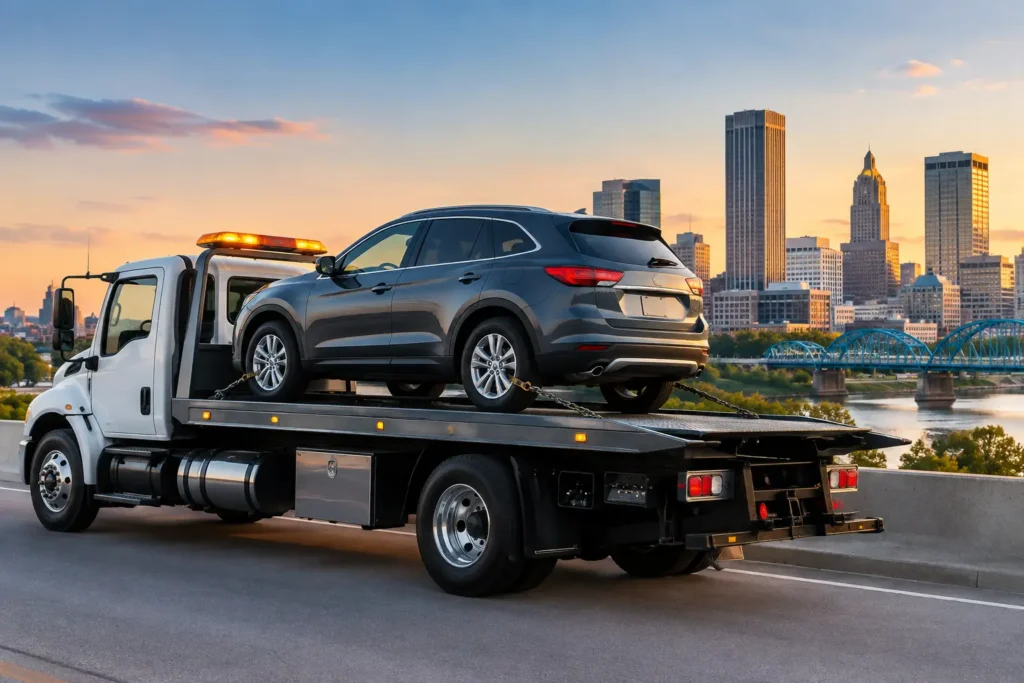
When the vehicle is damaged, the right equipment matters as much as the coverage. A car with suspension damage, a low front end, a truck with drivetrain concerns, or an electric vehicle should be loaded carefully. Flatbed towing is often the safer choice because it keeps all four wheels off the road and avoids adding damage to an already difficult situation.
Can you call your own tow truck?
Many insurance plans allow it, but not every plan handles payment the same way. There are generally two options. You can contact the insurer first and use the company they dispatch, or you can call a tow truck directly and submit for reimbursement if your policy allows it.
Calling your own local tow service can be useful when you need clear communication about a particular vehicle or pickup situation. This comes up with low-clearance cars in parking garages, heavy-duty pickups, or electric vehicles that need proper loading. It can also matter when a vehicle is blocked in at an apartment complex or stuck in a spot where a standard approach will not work.
Before authorizing service, ask your insurer whether outside towing is reimbursable and whether preapproval is required. Then ask the towing company for a clear estimate based on the pickup point and destination. There should be no guessing about where the vehicle is going or what the service involves.
What to have ready when you call insurance
A calm, accurate description helps both the insurance dispatcher and the tow operator send the right help. Have your policy number available if possible, along with the vehicle year, make, model, and exact location. If the car is in a garage, on a highway shoulder, or in a tight residential street, say so.
It also helps to explain what happened. “It will not start” is useful. “The front wheel is bent after a curb impact” is more useful. For an EV, mention that it is electric and whether it can be placed in tow mode. Those details affect how the vehicle should be handled.
If you are in a high-traffic area, focus on your safety while you wait. Move away from moving traffic when it is safe to do so, turn on hazard lights, and do not stand between your vehicle and the roadway. A tow can be arranged, but avoiding a second problem on the shoulder matters more.
When insurance may not pay for towing
Coverage can be denied or limited when roadside assistance was never added to the policy, the service exceeds the plan’s mileage or dollar allowance, or the reason for the tow falls outside the plan terms. Policies also differ on repeated service calls, off-road recovery, and winch-outs.
A vehicle stuck in mud, a ditch, or an unsafe area may require more than a normal tow. Winch-out work depends on access, the vehicle’s position, ground conditions, and the recovery needed to get it safely to solid ground. Some policies offer limited help for this work, while others do not cover it at all.
Do not assume a denial means you cannot get help. It only means the payment may be your responsibility. A reliable local operator can still assess the situation, explain the needed service, and transport the vehicle to the shop or location you choose.
A practical way to handle a covered tow
When your vehicle is down, start by checking your insurer’s app or roadside number for towing limits. If you need a specific local provider, confirm whether reimbursement is allowed. Then provide the tow company with the exact location, vehicle type, condition, and destination.
Tulsa Towing, powered by Neptune Towing, handles local flatbed towing and roadside situations with that same straightforward approach: determine what the vehicle needs, use the right equipment, and get it where it needs to go without creating more damage or confusion.
Insurance coverage is helpful, but it should not slow down a safe decision. Know your policy limits when you can, keep your insurance information accessible, and when the vehicle cannot move safely, make the call that gets you out of the road and headed to the right repair location.

