
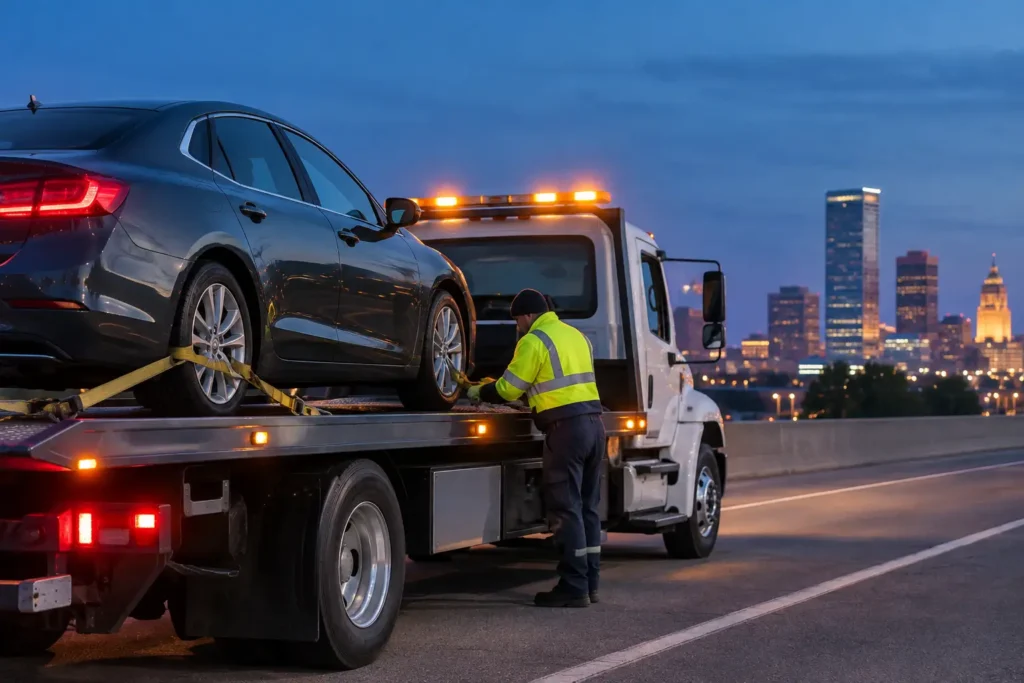
A stalled vehicle after dark changes the situation fast. Traffic has less time to see you, shoulders disappear into the dark, and a simple flat tire can feel a lot more serious on I-44 or US 75. This guide to safe night towing explains what to do from the moment your vehicle stops until it is loaded and headed to a repair shop, dealership, or another safe destination.
The priority is not diagnosing the problem on the roadside. It is getting yourself out of danger, making the vehicle visible, and giving the towing operator clear information so the right equipment arrives.
A Guide to Safe Night Towing Starts Before the Truck Arrives
The first few minutes matter most. If the vehicle is still moving, do not stop in the first available spot just because something feels wrong. Keep control of the vehicle, turn on your hazard lights, and move as far away from traffic as you safely can. A well-lit parking lot, wide shoulder, exit ramp, or side street is usually safer than stopping in an active lane.
That said, it depends on the vehicle and the road. If the engine is overheating, smoke is coming from under the hood, a tire has failed badly, or steering feels unsafe, pull over as soon as you can do so without creating another hazard. Do not try to push through traffic to reach the next exit if the vehicle may not make it.
Once stopped, keep the hazards on. At night, headlights and interior lights can also help drivers recognize that something is wrong, but do not leave high beams pointed into approaching traffic. If you are on a busy corridor near Downtown, Midtown, or South Tulsa, visibility is often more important than any roadside repair attempt.
Call for help from inside the vehicle if it is safe to remain there. Give the dispatcher your exact location, direction of travel, nearest exit, cross street, and a clear description of the vehicle. “Near Memorial” is not enough on a dark road. “Northbound US 75, just south of the 71st Street exit, white SUV on the right shoulder” gives the driver a real place to find you.
Do not stand beside traffic
A common mistake is getting out to inspect the vehicle while cars are passing close by. At night, drivers may not see you until the last second, especially in rain, fog, or glare from headlights. If your vehicle is safely off the road, stay inside with the doors locked and seat belt on unless conditions make that unsafe.
If the vehicle cannot be safely occupied because of smoke, fire, or another immediate danger, move well away from traffic. Get behind a guardrail when one is available, but do not stand directly in front of or behind the vehicle. A rear-end collision can push a disabled vehicle farther than people expect.
Reflective triangles or road flares can help, but only if you can place them without stepping into danger. They are not worth using on a narrow shoulder with fast-moving traffic. Hazard lights, a safe position, and a professional tow truck with warning lights are often the better plan.
Give the Tow Operator the Details That Affect Safety
Night towing goes smoother when the operator knows what they are coming to handle. The make, model, color, and license plate are useful, but the vehicle condition matters just as much. Say whether it starts, rolls, steers, shifts into neutral, has a flat tire, has collision damage, or is parked in a garage or tight lot.
This information determines how the truck is set up and whether a flatbed is the right approach. A vehicle with locked wheels, suspension damage, or a damaged front end may need extra care during loading. The goal is to avoid dragging a vehicle or making an existing problem worse simply because the situation was not explained clearly.
Electric vehicles deserve special attention. A Tesla or other EV should not be handled like a conventional car with a dead battery. The operator needs to know it is an EV before arrival, especially if the vehicle will not power on, cannot shift into transport mode, or has damage underneath. Proper loading points and a flatbed help protect the battery area, drivetrain, and low-clearance body panels.
The same goes for lifted trucks, all-wheel-drive vehicles, low sports cars, and vehicles with aftermarket modifications. A few clear details on the phone can prevent delays after the truck arrives.
Confirm the destination before loading begins
At night, repair shops may be closed even when their lot is accessible. Before the tow starts, decide where the vehicle needs to go and make sure the drop location makes sense. If it is going to a shop, ask whether there is a designated after-hours area and where keys should be left.
If you are having the vehicle brought home, choose a place with room for safe unloading. A narrow street, steep driveway, or crowded apartment lot can change the plan. In areas like Brookside or older parts of Midtown, tight streets and limited parking are common. Let the operator know about gates, sharp turns, low branches, or a driveway that cannot take a full-size tow truck.
What Safe Loading Looks Like After Dark
Once the tow truck arrives, the operator should position the truck to create a safer work area and use warning lights to make the scene visible. Give them room to work. Do not stand near the bed, cables, winch line, or vehicle wheels while loading is underway.
A flatbed is often the safest option for a disabled vehicle because all four wheels ride off the ground. That is especially useful for all-wheel-drive vehicles, EVs, accident-damaged cars, and cars with low clearance. It also reduces the risk of drivetrain damage that can happen when the wrong towing method is used.
You may be asked to release the parking brake, put the vehicle in neutral, provide keys, or confirm the destination. Follow instructions, but do not feel pressured to guess if you do not know how your vehicle works. Forcing a shifter, steering wheel, or electronic parking brake can create a bigger issue. Tell the operator what you know and let them use the proper procedure.
During loading, stay in a safe place the operator directs you to. On a highway shoulder, that may mean remaining in the tow truck cab or another protected area. In a parking lot, it may mean standing well clear of the loading path. The tow bed, winch cable, and vehicle can all move quickly once the process starts.
Before the truck leaves, take a quick look at the vehicle if conditions allow. Confirm where it is going, remove personal items you need, and make sure you have the keys, paperwork, and any medication or child seats needed for the night. If you are riding separately, confirm how you will get home or to the repair facility.
Night Conditions That Change the Plan
Rain is common enough in Tulsa to deserve its own caution. Wet pavement reduces traction for your vehicle, passing traffic, and the tow truck. It can also hide potholes, curbs, and debris around a disabled vehicle. Give the operator extra time to set up rather than expecting a rushed load in poor visibility.
A breakdown in a parking garage or apartment complex can be different from a highway call. Low overhead clearance may limit which tow truck can enter, while tight turns can make loading more complicated. Mention the location before dispatch, especially if you are in a covered garage near Downtown or parked in a cramped complex in East Tulsa.
After an accident, do not try to drive a vehicle just because it still starts. Fluid leaks, bent suspension parts, loose bumpers, or damaged wheels can make a short trip unsafe. If there is any doubt about whether it can be driven without causing more damage, a flatbed tow is the cautious choice.
Keep the Next Step Simple
A night breakdown is stressful because you are making decisions with limited visibility and often limited information. You do not need to solve the mechanical problem from the shoulder. Move to the safest available spot, make the vehicle visible, share an accurate location, and let an experienced operator handle the loading.
For drivers in Tulsa, Jenks, Bixby, and Broken Arrow, local route knowledge matters when the road is dark and traffic is still moving. Tulsa Towing, powered by Neptune Towing, focuses on clear communication and careful flatbed handling so the vehicle gets where it needs to go without adding more trouble to an already long night.
If the roadside does not feel safe, trust that instinct. Get protected first, then make the call that gets you and your vehicle out of the situation.

