
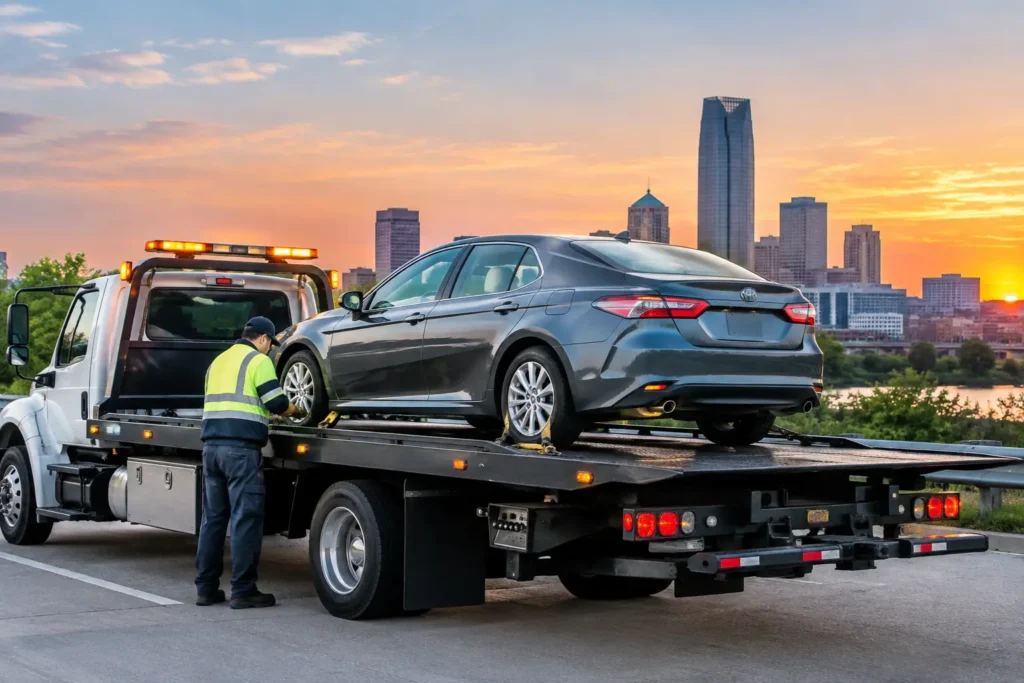
A real example of damage free towing is not just a vehicle arriving at a repair shop without a new scratch. It starts with the decisions made before the truck is even loaded. On a busy Tulsa afternoon, a driver with a low-clearance sedan was stranded in a Midtown parking lot after the car would not restart. The vehicle sat nose-first against a curb, with limited room in front and parked cars on both sides. Getting it out quickly mattered. Getting it out without tearing up the bumper mattered more.
The Call: A Low Car With No Room for Mistakes
The driver needed the car taken to a local repair shop, not pulled around the corner or left in a lot. The first question was not simply, “Where do you need to go?” It was whether the vehicle could roll, whether the steering wheel would unlock, and how much clearance was available around the front end.
Low cars create a problem that does not always show up until loading begins. A standard approach can put the front bumper, valance, or underbody too close to the ground or the edge of the bed. If the car is pulled at the wrong angle, the damage can happen in seconds.
In this case, the sedan could roll, but it could not be driven. That made a flatbed the right choice. The job was not about forcing the car onto the truck. It was about creating a safe loading angle, controlling the vehicle as it moved, and keeping every contact point where it belonged.
What This Real Example of Damage Free Towing Shows
Damage-free towing is a process. The equipment matters, but the operator still has to read the situation correctly. A flatbed does not automatically protect a vehicle if it is loaded carelessly, secured incorrectly, or unloaded in a rushed spot.
For this Tulsa call, the truck was positioned to give the sedan the straightest possible path out of the parking space. The bed was lowered and adjusted to reduce the loading angle. Extra care was taken around the curb because the vehicle had little clearance underneath.
The driver did not need a complicated explanation while dealing with a dead car. They needed to know what was happening: the car would be brought forward slowly, watched closely at the curb, loaded onto the flatbed, and delivered directly to the shop. Clear communication helps because there should be no guessing about how a vehicle will be handled.
The vehicle is checked before it moves
Before loading, the operator checks more than the obvious damage. Can the wheels turn? Is the parking brake stuck? Is the car in neutral? Does it have a flat tire that could make loading unstable? Is there loose bodywork, a damaged suspension component, or a hanging splash shield?
Those answers affect the plan. A car with locked wheels needs a different approach than a car that rolls freely. A vehicle with accident damage may need additional precautions so it does not shift or drag. An electric vehicle may have specific towing requirements that rule out pulling it with the drive wheels on the ground.
This sedan had no visible collision damage and rolled normally once it was placed in neutral. That made the loading process straightforward, but it did not remove the need for care around the low front end.
The loading angle is controlled
The flatbed was set low, and the car was brought up gradually. A slow load is not wasted time when the alternative is scraping a bumper or catching an underbody panel. The operator watched the front clearance as the vehicle passed the curb line and transitioned onto the bed.
This is where experience shows. Every driveway, parking lot, and curb cut is different. A smooth, level spot in Downtown Tulsa calls for one setup. A sloped lot near Tulsa Hills or a tight residential drive in South Tulsa may call for a different truck position or more room to work.
The goal is always the same: keep the vehicle moving in a controlled path without letting it bottom out, swing into an obstacle, or roll unexpectedly.
The car is secured by its wheels
Once the sedan was centered on the flatbed, it was secured using proper wheel restraints. The restraint system holds the vehicle at the tires rather than relying on a hook or chain attached to a random point underneath the car.
That distinction matters. Modern cars have plastic panels, low-mounted components, sensors, and suspension parts that are not made to be used as towing attachment points. Proper wheel securement helps keep the car stable during turns, braking, and bumps while avoiding unnecessary contact with the body or drivetrain.
The straps were checked for placement and tension before the bed was raised. The vehicle was then inspected again after it was in transport position. A careful tow includes that second look. Equipment can settle as the bed comes up, and it is better to correct a strap position before getting on the road.
The Drive Is Part of the Tow
Damage-free handling does not end when the car is on the truck. The route, turns, stops, and delivery location all matter. A loaded flatbed needs room to turn and stop smoothly, especially around traffic on Memorial Drive, Riverside, I-44, or US 75.
For this job, the repair shop had a clear entrance and enough lot space for a safe unload. That is worth confirming when possible. A tight shop lot can create another difficult angle, particularly when a vehicle cannot be driven off the bed under its own power.
At the shop, the flatbed was positioned on level ground. The sedan was lowered slowly and rolled off under control. It was placed where the shop could access it, not left blocking an entrance or squeezed into a spot that would make the next move harder.
The result was simple: the car arrived at the repair shop in the same condition it was in when it was loaded. No scraped bumper, no dragged underbody panel, and no extra problem for the owner to deal with.
Why the Right Method Depends on the Vehicle
Not every vehicle needs the same setup. A heavy-duty pickup, an all-wheel-drive SUV, a lowered car, and a Tesla each bring different concerns. Weight, ground clearance, wheel condition, drivetrain layout, parking position, and available space all change the safest way to load.
A vehicle that is stuck in mud or a ditch may need a controlled winch-out before it can be placed on a flatbed. A car with a broken wheel or serious accident damage may require additional stabilization. If the vehicle is in a parking garage with low overhead clearance, the available equipment and exit route have to be considered before a truck is sent in.
That is why a good tow begins with a few direct questions. It is not about making the call complicated. It is about sending the right equipment and avoiding a rushed solution that creates more damage.
What Drivers Can Do Before the Tow Truck Arrives
If it is safe, move personal items out of the vehicle and make sure the key is available. Tell the dispatcher if the car is lowered, electric, all-wheel drive, involved in an accident, blocked in, or parked near a curb, wall, or garage. A quick photo of the vehicle’s position can also help explain a tight situation.
Do not try to drag the vehicle with another car or force it out of a difficult spot. That can damage bumpers, suspension parts, or the transmission before a tow truck arrives. If the vehicle is in an unsafe traffic location, stay clear of traffic and follow any instructions given while help is on the way.
For drivers in Tulsa, Jenks, Bixby, or Broken Arrow, the practical standard is straightforward: the tow should solve the problem, not add another repair to the list. Careful flatbed loading, proper securement, and a clear plan from pickup to delivery are what make that happen. When your vehicle cannot move, look for a towing service that takes the time to handle the first few feet as carefully as the final mile.

