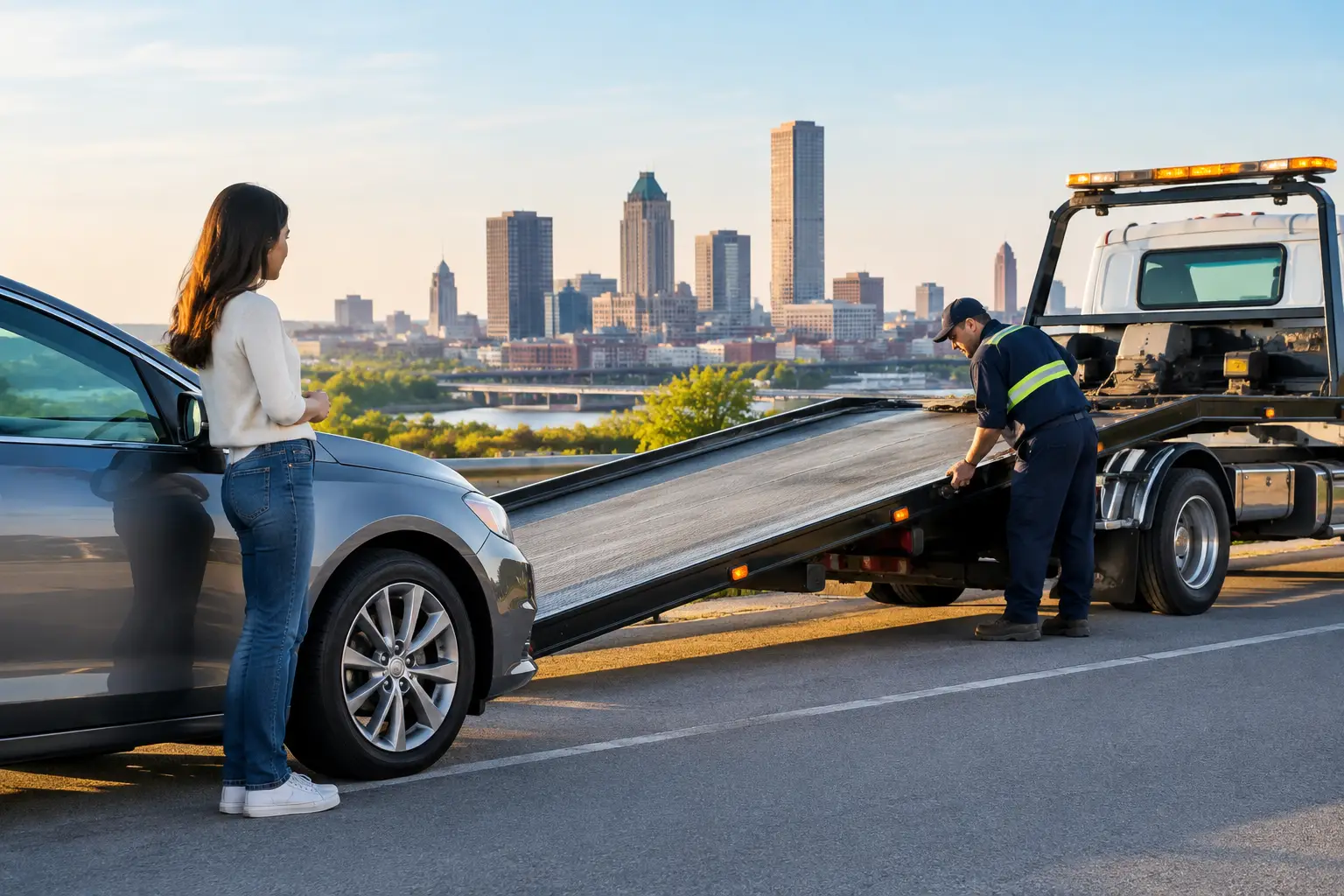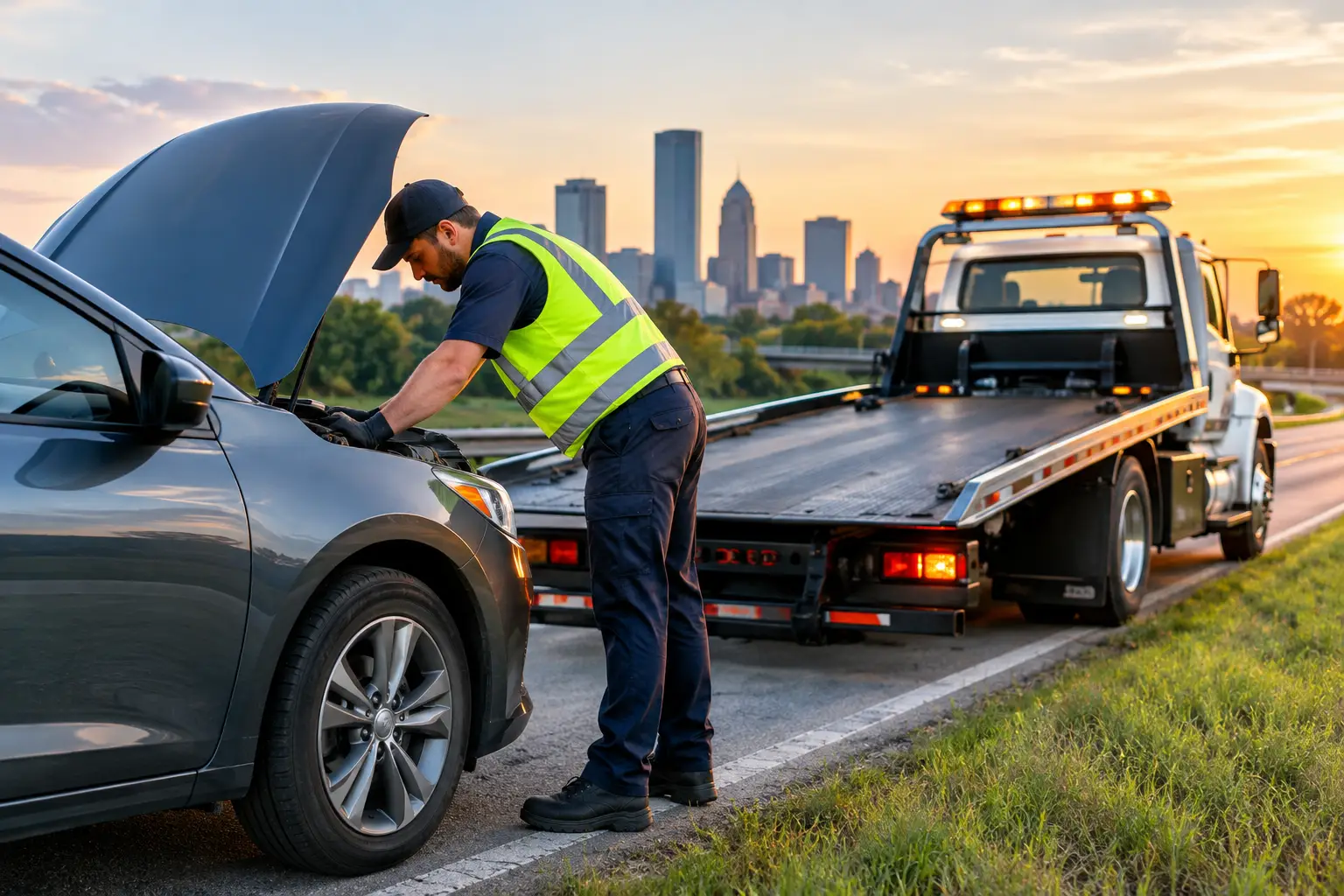
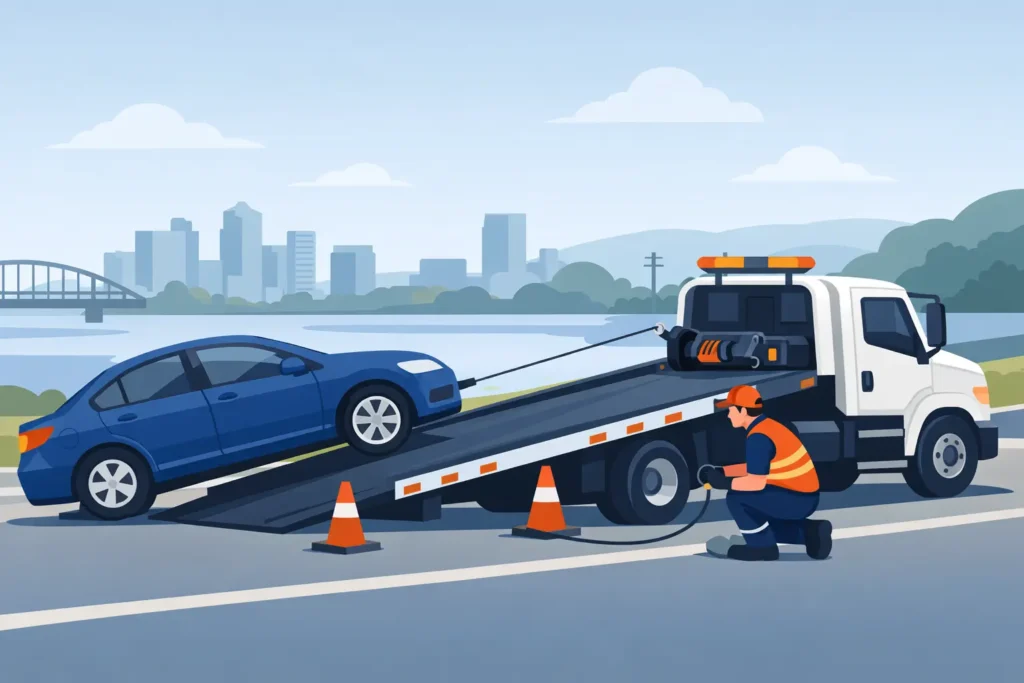
A car can be perfectly drivable one minute and impossible to tow the next. It may be sitting low in a ditch off Riverside, wedged against a curb after a minor accident, stalled at an angle in a parking garage, or stuck in soft ground after heavy rain. That is why cars need winching in certain roadside situations. The vehicle must first be moved into a safe, straight position before it can be loaded or transported without causing more damage.
Winching is not simply pulling a car harder. Done correctly, it is a controlled recovery process that uses the tow truck’s winch, proper attachment points, and careful positioning to move a vehicle where it can be safely loaded. Done carelessly, it can damage bumpers, suspension parts, underbody panels, tires, or drivetrain components.
What Winching Does Before a Tow
A tow truck winch is a powered cable system used to pull a vehicle in a controlled direction. In many jobs, the winch brings the car directly onto a flatbed. In others, it is used to recover the vehicle from a position where normal loading is not possible.
For example, a vehicle that has backed into mud beside a Tulsa apartment complex may have no traction and no safe path to drive out. A car involved in a crash on Memorial Drive may have a damaged wheel that will not roll. The winch gives the operator a way to move the vehicle slowly while keeping the truck, vehicle, traffic, and people around the scene in mind.
The key word is controlled. A recovery is not about yanking a car free. The operator evaluates where the vehicle is sitting, how it is resting, whether the wheels turn, and what direction will place the least stress on the vehicle. That assessment determines whether a direct pull works or whether the truck needs to be repositioned first.
Why Cars Need Winching in Real Roadside Situations
Cars need winching when their position, condition, or lack of traction prevents a safe drive-on load. The problem is often more than a car being “stuck.” Even a few feet of uneven ground, a locked wheel, or a steep approach angle can make a normal tow unsafe.
The Vehicle Cannot Move Under Its Own Power
A dead battery alone does not always mean a winch is needed. If the car rolls freely and is parked on level pavement, it may be loaded normally. But if it has a mechanical failure, transmission problem, locked brakes, or accident damage, the wheels may not turn as expected.
Trying to push or drive a disabled vehicle onto a truck can create risk for everyone involved. Winching allows the vehicle to be pulled onto the bed at a slow, steady pace without relying on the engine, transmission, or damaged parts to do their job.
The Car Is Off the Road or Has Lost Traction
Rain can turn a grassy shoulder, muddy construction entrance, or drainage area into a recovery call. The same goes for loose gravel, snow, slick clay, and soft ground around job sites or rural edges of the Tulsa area.
Spinning the tires usually makes the situation worse. The vehicle sinks farther, the ground gets more rutted, and the angle of recovery becomes more difficult. A winch can pull the car toward stable ground while reducing the need for repeated tire spin or sudden force.
Still, every soft-ground recovery has limits. If the vehicle is deeply buried, resting on its frame, or near a drop-off, the operator may need extra rigging, a different truck position, or more time to make the pull safely. The fastest-looking option is not always the right one.
An Accident Leaves the Car at an Unsafe Angle
After a collision, a car may be sideways across a lane, facing the wrong direction, against a guardrail, or sitting with one wheel in a curb line. It may look like a simple tow from a distance, but damaged steering, tires, suspension, and body panels can change the plan.
Winching lets the operator straighten or reposition the vehicle before loading it on a flatbed. This is especially useful on busy stretches such as I-44, US 75, and Highway 169, where traffic movement and scene safety matter as much as getting the vehicle moved.
The operator also has to avoid pulling against damaged components. A strap or connection point must be selected based on the vehicle’s condition, not just whatever metal is easiest to reach. Pulling from a bumper cover, control arm, or other weak area can turn a recoverable situation into a more expensive repair.
Low-Clearance Cars Need a Gentle Loading Angle
Sports cars, lowered vehicles, EVs, and many newer sedans can sit close to the ground. A steep loading angle may scrape the front bumper, air dam, battery shield, or underbody before the vehicle ever reaches the flatbed.
A winch is often the safer loading method because it moves the car gradually while the operator manages the approach. Proper loading equipment and careful bed positioning make a real difference here. For electric vehicles, this care is especially important because the battery pack and underbody components need protection during loading and transport.
A low car does not automatically require a complicated recovery. On level pavement with the right equipment, it can be straightforward. The mistake is assuming every vehicle can be pulled up the same way.
Tight Spaces Limit How the Tow Truck Can Line Up
Parking garages, narrow driveways, apartment lots, and crowded retail parking areas often leave little room to work. A tow truck may not be able to park directly in front of the vehicle, especially if traffic, walls, curbs, or other cars block the ideal line.
Winching can help move the vehicle out of a tight space and into a position where flatbed loading is possible. The operator must account for the cable angle, wheel direction, clearance around the car, and the path it will travel. A few inches can matter when a car is near a concrete post or parked vehicles.
What a Careful Winch-Out Looks Like
A proper winch-out starts with an on-scene check, not an immediate pull. The tow operator looks at the vehicle’s location, damage, ground conditions, available access, and the safest direction of movement. If the car is in traffic, the work area also has to be managed so the recovery does not create another hazard.
Next comes truck placement. The tow truck needs a stable position and a pull angle that keeps the recovery controlled. Pulling from the wrong direction can drag a vehicle deeper into a ditch, push it toward an obstacle, or place unnecessary side stress on suspension and steering parts.
The connection point matters just as much. Modern vehicles have designated recovery points, and those are preferable when accessible and appropriate for the job. In other cases, the operator uses equipment and techniques suited to the vehicle’s condition. There is no one-size-fits-all attachment method, especially after an accident.
During the pull, the vehicle is moved slowly and watched closely. The operator checks for wheel movement, shifting ground, dragging bodywork, and anything that could change the plan. Once the car reaches stable pavement or a safe loading position, it can be secured correctly on the flatbed for transport.
When a Winch-Out Is Better Than Trying to Drive Away
Drivers sometimes try to solve a stuck situation by rocking the car back and forth, flooring the accelerator, or asking several people to push. That may work on dry, level ground when the vehicle is only lightly stuck. It is a poor choice when the wheels are spinning, the vehicle is near traffic, the car is sitting unevenly, or there may be hidden damage.
Repeated acceleration can dig deeper holes in mud and strain the drivetrain. Pushing a car beside a busy road exposes people to traffic. Trying to move an accident-damaged vehicle can cause a loose part to catch, a tire to fail, or the vehicle to shift unexpectedly.
If the car will not move normally, stop before the situation gets worse. Keep people clear of the vehicle’s path, avoid standing downhill from it, and explain the position honestly when requesting help. Details such as “front wheels are in a ditch” or “the car is blocked in a garage” help dispatch the right equipment.
The Goal Is Recovery Without Added Damage
The reason for winching is simple: get a vehicle from an unsafe or immovable position to a safe loading position without making the original problem worse. It takes the right truck placement, the right connection, and patience during the pull.
For drivers in Tulsa, Jenks, Bixby, or Broken Arrow, a stuck or disabled car does not need more guesswork at the roadside. Tulsa Towing handles winch-out situations with flatbed equipment and a practical focus on moving the vehicle carefully, then getting it where it needs to go. When the vehicle cannot safely drive or roll onto the truck, a controlled winch recovery is often the step that protects it.